










Key Takeaways
- Inspect trees at least seasonally and again after significant storms.
- Heat, saturated soil, wind, and freezing weather can create different stresses.
- Fresh cracks, hanging limbs, lifted roots, and sudden leaning deserve prompt attention.
- Pruning should improve tree health and structure, not simply change appearance.
- Keep clear of utility lines and leave hazardous tree work to qualified professionals.
Fayetteville yards often combine mature shade trees, newer landscape plantings, wooded edges, driveways, sidewalks, and homes that sit close to the canopy. That setting makes regular tree care important. Problems such as dead limbs, weak branch connections, root disturbance, and trunk cracks can begin quietly and then become more noticeable after heavy rain, strong winds, or summer heat.
A simple seasonal routine helps property owners spot concerns before they become urgent. For a local assessment when a tree needs closer attention, 770 Tree Guy, also known as 770-Tree-Guy, provides Fayetteville-focused information on pruning, removal, stump grinding, arborist consultations, tree health, lot clearing, and emergency work. The company serves Fayetteville and other South Metro Atlanta communities and describes support from ISA-certified arborists for evaluating tree condition, structure, and potential hazards.
Why Fayetteville Trees Need a Seasonal Plan
Georgia summers can be hot, rain can arrive in heavy bursts, and thunderstorms can place extra strain on branches and roots. Wet ground may reduce a tree’s stability when roots are already damaged or shallow, while wind can expose deadwood and weak limb unions. Winter weather can also break vulnerable limbs or worsen existing defects. Fayetteville’s public interest in protecting its canopy is evident in activities such as the city’s Arbor Day tree-planting, but healthy community trees also begin with attentive care on individual properties.
Many Fayetteville properties sit on Piedmont soils with substantial clay content, which can drain slowly after a storm and hold water around the root zone longer than homeowners expect. Heavy clay compacts easily when yards are used for parking, play, or construction staging, and that compaction limits the oxygen roots need. Neighborhoods that were cleared for development may also have fill soil, buried debris, or grade changes near trunks. Mature oaks, loblolly pines, maples, and dogwoods growing alongside newer plantings each respond differently to these conditions, so a routine look at the soil surface is as valuable as a look at the canopy.
Use the calendar below as a practical visual-inspection guide. It is not a substitute for an on-site assessment when a large tree is near a roof, driveway, sidewalk, road, play area, or utility line.
January Through March: Check Winter Damage and Drainage
Winter is a useful time to see the branch structure of many deciduous trees. Walk the property after wind or heavy rain, but look up before walking beneath the canopy. Watch for broken limbs caught overhead, new trunk splits, peeling bark around old wounds, exposed roots, or soil that has washed away from the base of a tree.
- Notice whether a tree has developed a new or more pronounced lean.
- Check for branches contacting roofs, chimneys, fences, vehicles, or service lines.
- Remove only small fallen twigs and loose debris from paths and lawns.
- Keep mulch away from the trunk flare rather than piling it against the bark.
- Clear drainage paths carefully so water is not repeatedly pooling at the tree’s base.
A limb that remains attached after a winter storm is not necessarily safe. It may fall later when wind, rain, or its own weight shifts the damaged wood.
April Through May: Review New Growth and Root Zones
Spring growth makes it easier to compare one part of a canopy with another. Look for branches that remain bare while nearby limbs leaf out normally, rubbing branches, crowded growth, and deadwood. At ground level, inspect for damaged bark, unusual swelling, mushrooms, or changes around the root zone.
Spring Questions to Ask
- Did the tree leaf out evenly for its species and location?
- Is water standing near the trunk after ordinary rainfall?
- Has foot traffic, parking, or construction compacted soil over major roots?
- Are roots lifting nearby pavement or creating a trip concern?
- Is mulch covering the trunk instead of resting around the outer root zone?
Newly planted trees can need supplemental water during dry periods. Apply water slowly over the root area rather than against the trunk. Avoid applying fertilizer simply because a tree looks stressed, since watering, soil conditions, pests, disease, or root injury may be the actual issue.
June Through August: Manage Heat, Drought, and Storm Risk
During hot weather, trees lose moisture through their leaves while soil can dry quickly. Deep, slow watering is generally more helpful than brief daily sprinkling because it reaches farther into the root zone. A layer of mulch can reduce evaporation, provided it does not touch the trunk. Watch for curled leaves, scorched leaf edges, early leaf drop, and reduced growth.
Summer also calls for storm readiness. Identify dead limbs before severe weather arrives, move vehicles away from visibly compromised trees when practical, and secure outdoor items that could be damaged by falling branches. Fayetteville residents can use the city’s weather report and lightning alert system at City Center Park as one local reminder to make outdoor decisions with changing conditions in mind.
Fayetteville’s summer afternoons often bring fast-moving thunderstorms that drop heavy rain in a short window, followed by hot sun that quickly dries the surface. That cycle stresses trees with saturated roots and dry upper soil at the same time. After a storm, check whether soil near the trunk remains soft, whether branches have shifted, and whether water is ponding in low spots of the yard. Those observations help you decide whether a tree needs monitoring or prompt professional attention.
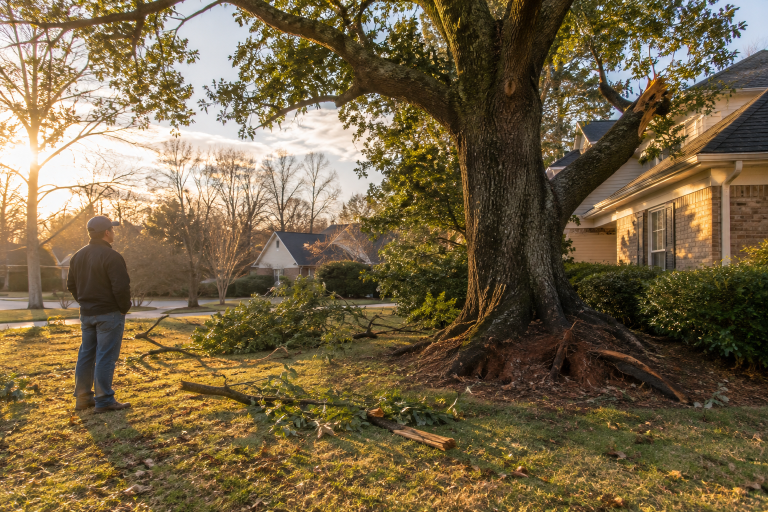
When a tree or major limb has fallen on a structure, blocks essential access, or has shifted noticeably after a storm, treat the area as a safety issue. Do not approach wires, climb the tree, or pull on hanging wood with a rope or vehicle. Property owners facing those conditions can review emergency and storm tree services for examples of situations that require professional response.
September Through November: Inspect After Storm Season
Fall is a good time for a full property walk, even if no tree has fallen. Look for lifted soil near the base, fresh cracks where large limbs join the trunk, broken branch stubs, and repeated contact between branches and gutters or roof edges. Normal seasonal leaf color change is expected, but sudden dieback in one section of the canopy deserves closer review.
Post-Storm Inspection Checklist
- Look overhead before entering the area beneath a tree.
- Stay outside the drop zone of hanging or split limbs.
- Assume every downed wire may be energized and keep people and pets away.
- Photograph damage from a safe distance for documentation.
- Contact the utility or appropriate emergency agency if lines or public access are affected.
- Arrange an evaluation for damaged trees near structures or frequently used areas.
How to Recognize a Potentially Dangerous Tree
Not every leaning or damaged tree requires removal. Risk depends on the tree’s condition, its location, the direction of any lean, the presence of decay, and what could be struck if it fails. However, several warning signs should not be ignored: a fresh trunk split, a large dead limb over a target, exposed or torn roots, soft decayed wood, a sudden change in angle, or branches resting on utility lines.
Do not stand beneath a damaged branch to cut it, use a ladder near unstable wood, or assume a leafy tree is structurally sound. Leaves can remain present even when a trunk, root system, or major limb has a serious defect.
Matching the Problem to the Right Type of Tree Care
- Dead, rubbing, or overcrowded branches: Ask whether targeted pruning can improve clearance and structure.
- A tree threatening a home or driveway: Request a hazard assessment and ask whether retention is possible.
- A remaining stump: Discuss stump grinding, desired depth, and plans for the area afterward.
- Thin growth or unusual leaf loss: Consider an arborist consultation to examine soil, roots, pests, disease, and site conditions.
- Dense growth on an undeveloped lot: Discuss selective clearing and which established trees should be protected.
Choosing a Qualified Tree Care Professional
Before approving work, ask for a written scope that explains what will be removed or pruned and why. Confirm insurance, cleanup expectations, equipment access, and whether stump work is included. For expensive or complex projects, it is reasonable to obtain more than one opinion. Be cautious when someone recommends removing every tree without identifying the specific structural, health, or location-related concern.
Fayetteville homeowners also benefit from hiring a company that understands the conditions in South Metro Atlanta. Clay soils, summer thunderstorms, and tight suburban lots mean that a crew must plan equipment placement, protect lawns and driveways, and consider how debris will be handled on narrow streets. Ask how the company will protect the root zone during work, whether it will haul away brush and wood, and how it will document recommendations so you can compare them with later inspections.
When you are ready to schedule an on-site review in Fayetteville, you can reach 770 Tree Guy | 238 1st Manassas Mile, Fayetteville, GA 30215, United States | (770) 629-8715 | https://www.770treeguy.com/
Conclusion
Tree care in Fayetteville, Georgia does not have to be complicated. A few careful inspections throughout the year can reveal drainage problems, damaged limbs, root disturbance, poor canopy structure, and storm-related changes before they become larger concerns. Protect the root zone, pay attention after severe weather, and seek qualified help whenever a tree could affect a home, vehicle, road, walkway, or utility line.