










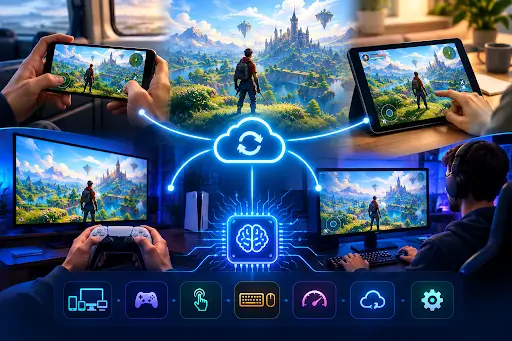
Players don’t stay on a single device anymore. Someone might start a game on their phone during a commute, continue it on their tablet at home, then finish a session on their console. That cross-platform expectation has moved from nice-to-have feature to baseline requirement, yet building games that work seamlessly across different platforms remains technically complex and resource-intensive. AI game development is simplifying this by handling the cross-platform infrastructure automatically, letting creators focus on designing the game experience rather than solving platform-specific technical problems. That automation transforms cross-platform development from something only large studios could practically attempt into something solo developers and small teams can realistically achieve.
Why Cross-Platform Matters Now
The traditional approach to multi-platform games meant building separate versions for each platform, each with its own codebase, its own bugs, its own maintenance burden. That duplication consumed resources and created friction that discouraged supporting multiple platforms. Many excellent games stayed exclusive to a single platform not because the creator preferred it that way, but because supporting multiple platforms would have consumed resources better spent on development.
Players have come to expect differently. Someone who invests time in a game expects that progress to follow them everywhere they go. Missing cross-platform support feels like a limitation, not an intentional design choice. Players increasingly move between devices naturally throughout their day, and games that force them to stay on a single platform feel restrictive by comparison to alternatives that let them play anywhere.
That expectation creates opportunity for creators willing to support it. A game available across platforms reaches far more potential players than a single-platform exclusive. Someone who might have ignored a mobile-only game suddenly becomes interested when that same game works on their console too. That expanded reach directly impacts player acquisition and retention.
How AI Simplifies Cross-Platform Development
Handling Platform Differences Automatically
Different platforms have different hardware, different screen sizes, different input methods, different performance characteristics. Traditional development meant writing platform-specific code for each of these differences. AI game development abstracts those differences, handling them automatically so creators write the game logic once and it adapts to whichever platform someone plays on.
That abstraction doesn’t require creators to understand platform-specific optimization. The system handles resolution scaling, input mapping, performance tuning, all the technical details that used to consume enormous development time. A creator designs the experience, and the platform automatically optimizes it for each device.
Syncing Progress Seamlessly Across Devices
The most important aspect of cross-platform play is seamless progress synchronization. A player should be able to quit on their phone mid-game, pick up their tablet an hour later, and continue exactly where they left off. That synchronization used to require building complex backend systems and debugging countless edge cases. Modern AI-assisted development handles that infrastructure automatically, storing progress in the cloud, syncing across devices, handling conflicts when the same account accesses multiple devices simultaneously.
That automatic synchronization is genuinely transformative for player experience. Players stop thinking about which device they’re playing on and just play wherever is most convenient. That convenience directly translates to engagement, since it removes friction from the experience.
Optimizing For Each Platform’s Strengths
Different platforms have different capabilities. A console has high performance but requires a controller. A mobile device has touch input and limited battery. A PC has keyboard and mouse. Rather than forcing a single experience across all platforms, intelligent cross-platform development optimizes for each platform’s strengths. Console controls feel native to console play. Touch controls feel native to mobile. PC experience leverages mouse precision. That optimization means players get the best experience for their specific device rather than a compromised middle ground.
Managing Platform-Specific Features
Each platform has unique capabilities worth leveraging. Console-specific features, mobile-specific gestures, PC-specific precision controls, all of these can enhance the experience without requiring the entire game to be rebuilt for each platform. Modern development automatically handles integrating platform-specific features when available and falling back to universal experience when not. That flexibility means leveraging platform strength without creating inconsistency.
Building Cross-Platform Games Effectively
Design Core Experience That Works Everywhere
The foundation of successful cross-platform games is a core experience that works well regardless of platform. That doesn’t mean identical experience, it means core gameplay that translates across devices. A puzzle game’s core logic works on mobile and console equally. An action game’s core movement and combat translate across platforms. That universal core is what you build on, then you optimize for platform-specific strengths.
This requires thinking about what actually matters to your game. Does your experience need high frame rates? Different platforms will deliver different performance, so understanding acceptable performance ranges matters. Does your game depend on specific input precision? Different platforms have different input characteristics, so designing input that works across devices matters. Understanding core requirements early guides how you approach cross-platform design.
Plan Progression Around Player Mobility
Cross-platform games should anticipate that players will move between devices. That means progression that doesn’t require being on a specific device, progression that’s accessible anywhere. A player shouldn’t need a console to advance a story, or a PC to complete a quest. Progression should work naturally across devices without requiring platform-specific action.
This also means designing sessions that work on whatever device someone has available. A mobile session might be shorter than a console session, so designing progression that feels meaningful in short bursts makes cross-platform play natural rather than forcing specific session lengths.
Test Performance Across Actual Devices
Cross-platform development requires testing on actual hardware, not just assuming performance will scale correctly. A game that runs smoothly on high-end hardware might perform poorly on older mobile devices or lower-spec consoles. That performance testing needs to happen continuously, not as a late-stage check. Modern AI tools support automated performance testing across different device tiers, identifying performance problems as they’re introduced rather than discovering them during dedicated testing phases.
A Practical Example of Cross-Platform Design
Aero Auto Transporter demonstrates what cross-platform development produces, a game that plays well regardless of where someone chooses to play it. The game shows how thoughtful cross-platform design creates cohesive experience across different devices rather than feeling like a compromised version of separate games.
Learning how to use an AI game maker to develop cross-platform games means focusing on core experience that translates across devices, letting the platform handle device-specific optimization and synchronization automatically.
What Players Actually Value In Cross-Platform Games
Players value consistency most of all. A game that feels the same across platforms, where progress syncs reliably, where they don’t wonder whether a feature works on their current device, feels polished and professional. Conversely, a game where the experience feels different on different platforms, where syncing is inconsistent, where features work on some devices but not others, feels broken.
Players also value control choice. Being able to use their preferred input method, having game feel responsive to their control style, matters for comfort and engagement. A cross-platform game that forces console controls on mobile users frustrates them. One that automatically adapts to available controls feels thoughtful.
Challenges In Cross-Platform Development
Performance Parity Across Different Hardware
The biggest challenge in cross-platform development is maintaining consistent performance across wildly different hardware capabilities. A game running at 60 frames per second on a console might struggle to reach 30 frames per second on mobile. That performance difference changes how the game feels. Modern AI tools help manage this by automatically scaling graphics and physics quality based on hardware, but it still requires thoughtful design about what can be scaled without breaking experience.
Managing Multiple Input Methods
A game designed around controller input doesn’t automatically work well with touch. Conversely, a touch-optimized game might feel awkward with a controller. That input complexity requires intentional design about how to handle each input type. Modern tools support mapping input methods, but that mapping still requires thinking about what each input does and how different devices handle it.
Keeping Experiences Aligned
As cross-platform games evolve, keeping features consistent across platforms requires discipline. A feature added for one platform needs to either work across all platforms or be explicitly platform-exclusive. Allowing drift between platforms creates fragmented experience where what works on one device doesn’t work on another.
The Future of Cross-Platform Games
As players become more accustomed to seamless cross-platform experiences, games without that support increasingly feel outdated. The transition to expecting cross-platform support is nearly complete, and that expectation is reshaping industry standards. Games that support multiple platforms have competitive advantages over single-platform exclusives, simply because they reach more players and let those players engage on their terms.
That shift is democratizing game development because cross-platform infrastructure that used to require enormous resources is increasingly handled automatically. A solo developer can now build cross-platform games that used to require large teams just to handle platform-specific optimization and synchronization.
Final Thoughts
AI game development for flexible cross-platform games means building core experiences that work naturally across different devices, letting the platform handle device-specific optimization and synchronization automatically, and testing performance continuously to ensure consistent experience. Design progression that doesn’t require specific devices, plan sessions that work in different durations, optimize for each platform’s strengths while maintaining core experience consistency. The result is games that feel seamless regardless of where someone chooses to play, that feel polished rather than compromised, that respect player choice about which device to use. That cross-platform flexibility isn’t a luxury feature anymore, it’s increasingly a baseline expectation that separates modern games from outdated single-platform experiences.