








Quad Equalizer is an audio technology commonly associated with a four-band equalization system that allows users to adjust different parts of the sound spectrum. Whether you are listening to music, recording vocals, mixing tracks, or configuring a speaker system, an equalizer can help create a more balanced and enjoyable audio experience. By providing separate controls for different frequency ranges, a quad equalizer offers greater flexibility than basic bass and treble adjustments without overwhelming users with dozens of settings.
Sound quality is not determined by volume alone. Two audio tracks played at the same volume can sound completely different because of their frequency balance, recording quality, speakers, and listening environment. Some recordings have excessive bass, while others sound sharp, muddy, or lack vocal clarity. A quad equalizer gives listeners and audio professionals a practical way to address these issues.
Understanding its controls, functions, and applications can help you make better audio adjustments and get more value from your sound equipment.
What Is a Quad Equalizer?
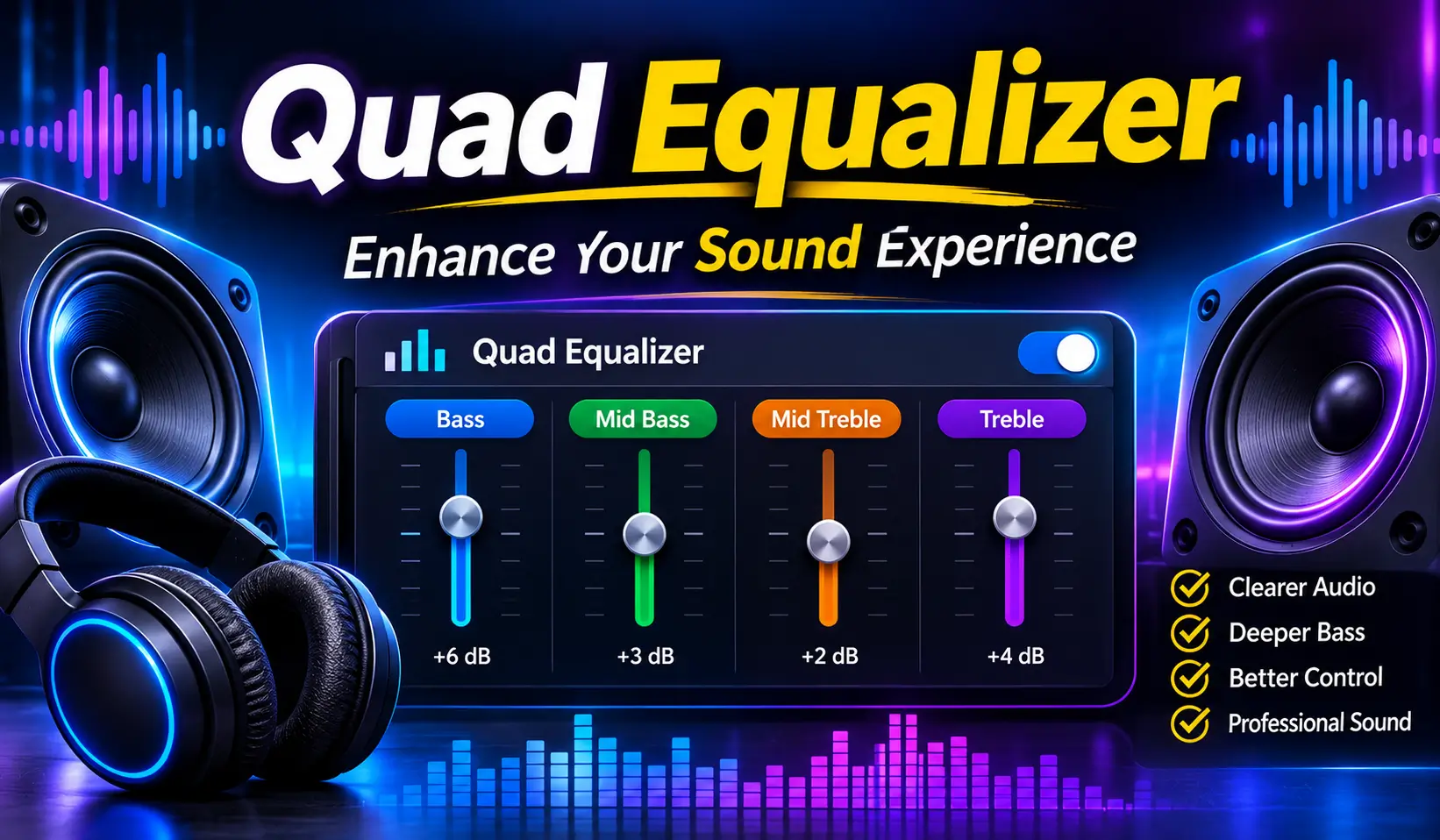
A quad equalizer is generally understood as an equalization system with four adjustable frequency bands or, in certain technical applications, four independent signal-processing channels.
In everyday audio discussions, the term usually refers to a four-band equalizer. Each band controls a different portion of the audio frequency spectrum. Users can increase or decrease selected frequencies to change the overall character of the sound.
A typical four-band audio equalizer includes:
- Low frequencies: Control bass and the deeper elements of sound.
- Low-mid frequencies: Influence warmth, body, and fullness.
- High-mid frequencies: Affect vocal presence, detail, and clarity.
- High frequencies: Control treble, brightness, and finer sound details.
The exact frequency ranges depend on the design of the equipment or software. Some equalizers offer fixed frequency points, while others allow users to adjust the centre frequency and bandwidth.
The main purpose is to provide useful sound control through four relatively simple adjustment sections.
How Does a Quad Equalizer Work?
A quad equalizer works by changing the level of selected frequency ranges within an audio signal. Instead of increasing or decreasing the volume of the entire recording, it allows users to make targeted tonal adjustments.
For example, if a song sounds too bass-heavy, reducing the low-frequency band can create a more balanced presentation. If vocals sound unclear, a small adjustment in the midrange may improve their presence.
The process generally involves three basic actions:
- Frequency selection: Identifying the part of the sound spectrum that needs adjustment.
- Gain adjustment: Increasing or decreasing the selected frequency range.
- Listening and refinement: Evaluating the result and making additional changes when necessary.
Some advanced equalizers also include a Q control. This setting determines the bandwidth of the adjustment, allowing users to affect a wider or narrower frequency area.
A basic four-band model may provide only simple gain controls, while a more advanced parametric design can offer additional flexibility.
Understanding the Four Main Frequency Bands
Learning what each frequency band does is essential for using a quad equalizer effectively. Every section contributes differently to the overall listening experience.
1. Low Frequencies: Controlling Bass
Low frequencies are responsible for the deeper elements of music and audio. They provide the weight and impact associated with bass instruments, kick drums, and other low-pitched sounds.
When the low-frequency range is balanced, music can feel full and powerful. However, excessive bass may make recordings sound boomy or overpower other instruments.
A quad equalizer allows users to reduce or increase this range according to their preferences.
For example, listeners who enjoy electronic music may prefer stronger bass, while people listening to spoken-word recordings may benefit from a cleaner low-frequency balance.
2. Low-Mid Frequencies: Creating Warmth and Body
The low-mid range contributes to the fullness of instruments and voices. It helps determine whether an audio recording sounds warm, thick, or muddy.
Too much energy in this area can make vocals and instruments difficult to distinguish. On the other hand, excessive reduction can make the sound feel thin and unnatural.
Careful adjustments can help separate different elements of a recording without dramatically changing its overall character.
This frequency area is particularly important when working with acoustic instruments, vocals, and music arrangements containing several overlapping sounds.
3. High-Mid Frequencies: Improving Presence and Clarity
High-mid frequencies influence how clearly listeners perceive vocals, guitars, and many other instruments.
When this range is properly balanced, individual sounds can become easier to recognize. It can also help vocals stand out within a busy musical arrangement.
However, excessive boosting may introduce harshness or listening fatigue. Some recordings already contain strong high-mid energy, so adding more is not always beneficial.
A quad equalizer provides an opportunity to make small corrections based on the recording and listening environment.
4. High Frequencies: Adjusting Treble and Brightness
High frequencies contribute to the brightness and finer details of audio. They influence elements such as cymbals, vocal consonants, and the subtle high-frequency components of instruments.
Increasing this range can make some recordings sound more open and detailed. Reducing it may help soften audio that feels too sharp or unpleasant.
The correct adjustment depends on the source material, headphones, speakers, and personal listening preferences.
A balanced high-frequency response should provide detail without making the sound uncomfortable.
Main Features of a Quad Equalizer
Although different models and software applications offer different capabilities, several features are commonly associated with four-band equalization.
Independent Frequency Adjustment
The ability to control separate frequency ranges is the central feature of a quad equalizer. Users can adjust one section without deliberately changing the gain of every other section.
This makes it easier to correct specific tonal problems.
Boost and Cut Controls
Most equalizers allow users to boost or cut selected frequencies.
Boosting increases the level of a frequency range, while cutting reduces it. Both adjustments can influence how instruments and voices are perceived.
In many situations, a small reduction is more effective than a large boost because excessive boosting can reduce available headroom.
Adjustable Frequency and Bandwidth
Some advanced designs allow users to select the centre frequency and bandwidth of individual bands.
This provides greater precision when correcting unwanted sounds or shaping particular instruments.
These controls are not available on every four-band equalizer, so it is important to check the specifications before selecting a particular device.
Preset Configurations
Digital equalizers may include presets designed for different listening situations.
Common examples include music, speech, cinema, gaming, and acoustic listening modes. Presets can be useful starting points, although they should not be treated as universally perfect settings.
Analog and Digital Operation
Quad equalization can be implemented through physical audio equipment or digital software.
Analog units use electronic circuits to shape the signal, while digital equalizers process audio through software or digital signal-processing hardware.
Both approaches can be useful depending on the equipment, workflow, and desired level of control.
Benefits of Using a Quad Equalizer
A quad equalizer offers several advantages for everyday listeners and people working with audio production.
Better Sound Balance
One of its biggest benefits is the ability to adjust the tonal balance of an audio recording. Users can reduce excessive bass, improve midrange clarity, or soften harsh treble.
These adjustments can make listening more comfortable and enjoyable.
Simple Controls for Beginners
A four-band layout is generally easier to understand than a highly detailed equalizer with numerous frequency sliders.
Beginners can learn the basic relationship between bass, mids, and treble without immediately dealing with complicated audio-processing techniques.
More Control Than Basic Tone Settings
Traditional audio systems sometimes offer only bass and treble controls. A quad equalizer introduces additional adjustment points, giving users more control over the middle frequencies.
This can be particularly helpful for improving vocal clarity and reducing muddiness.
Useful for Different Audio Sources
A four-band equalizer can be used with various types of audio, including music, podcasts, videos, voice recordings, and live sound.
Its usefulness depends on the design and compatibility of the equipment.
Flexible Listening Experience
Different people have different listening preferences. Some enjoy powerful bass, while others prefer a more neutral and balanced presentation.
Equalization makes it possible to adjust the sound according to individual preferences and the characteristics of the listening environment.
Where Is a Quad Equalizer Used?
Four-band equalization can be useful in several audio environments. Its practical applications depend on the type of equipment and the available controls.
Home Audio Systems
Home audio users may use equalization to adjust speakers according to room acoustics and personal preferences.
A room with strong bass reflections, for example, may make certain recordings sound heavier than intended. Reducing excessive low-frequency energy can sometimes improve the listening experience.
However, equalization cannot completely correct every acoustic problem. Speaker placement and room treatment also matter.
Car Audio Systems
Car audio systems operate in relatively small spaces with reflective surfaces, road noise, and varying speaker positions.
Equalizer controls allow drivers and passengers to adjust the sound according to their preferences. A four-band system can provide a straightforward way to modify bass, midrange, and treble.
Music Production and Recording
Audio engineers use equalization during recording, mixing, and other production stages.
A four-band EQ can help shape vocals, instruments, and individual audio tracks. It can also be used to reduce unwanted frequency buildup and improve separation between different sound sources.
Professional production may require more advanced equalization tools, but a four-band design can still be useful for broad tonal adjustments.
Live Sound Systems
Live sound engineers work with microphones, instruments, speakers, and different acoustic environments.
Equalization helps them manage tonal balance and address certain sound problems during performances. A suitable four-band unit can provide accessible adjustments when a more complex system is unnecessary.
Headphones and Audio Software
Some headphone applications and music players include equalizer settings.
Users can modify the sound profile to suit their preferred listening style. Software-based equalization also makes it possible to save custom profiles and switch between different configurations.
Quad Equalizer vs. Graphic and Parametric Equalizers
Not all equalizers offer the same level of control. Understanding the differences can help users select the right option.
| Equalizer Type | Main Characteristics | Typical Use |
|---|---|---|
| Quad Equalizer | Four frequency bands or four processing channels, depending on the design | Basic to intermediate sound adjustment |
| Graphic Equalizer | Multiple fixed-frequency controls | Broad frequency shaping |
| Parametric Equalizer | Adjustable frequency, gain, and bandwidth on supported bands | Precise audio correction and mixing |
A quad equalizer describes the number of bands or channels rather than one universal filter design. A four-band equalizer can also be parametric if it provides the necessary controls.
A graphic equalizer generally uses fixed frequency points, while a parametric equalizer offers more precise control over individual frequency ranges.
The right choice depends on how much adjustment you need. Casual listeners may find four bands sufficient, whereas experienced audio professionals may prefer more detailed processing options.
How to Set Up a Quad Equalizer Correctly
Getting good results does not require complicated adjustments. A careful approach can help you understand the effect of each control.
Start With a Flat Setting
Begin by placing all four frequency controls at their neutral positions. This gives you a reference point for evaluating the original audio.
Avoid making several large adjustments before listening to the source material.
Identify the Problem
Pay attention to what sounds incorrect.
Does the music have too much bass? Are vocals difficult to understand? Does the treble sound sharp?
Identifying the issue first helps you choose the appropriate frequency range.
Make Small Adjustments
Change one band at a time and listen carefully. Small adjustments often produce more natural results than extreme boosts or cuts.
If the sound becomes less balanced, return the control toward its original position.
Compare Before and After
Switch between the adjusted and original settings whenever possible.
This makes it easier to identify whether the equalizer has genuinely improved the sound or simply made it louder or different.
Consider Your Equipment
Headphones, speakers, amplifiers, and listening environments all influence the final result.
A setting that works well with one pair of headphones may not produce the same experience with another system.
Common Mistakes to Avoid When Using a Quad Equalizer
Equalization is useful, but poor adjustments can negatively affect sound quality.
Some common mistakes include:
- Excessive bass boosting: Too much low-frequency energy can overpower vocals and other instruments.
- Overusing treble: Strong high-frequency boosts may make recordings sound harsh.
- Changing every band simultaneously: This makes it difficult to identify which adjustment caused a particular result.
- Ignoring the original recording: Not every audio problem can be fixed through equalization.
- Using the same settings everywhere: Different speakers and headphones may require different adjustments.
- Confusing volume with sound quality: A louder signal can seem more impressive without actually being more balanced.
The best approach is to make intentional adjustments and listen to the results rather than relying on extreme settings.
How to Choose the Right Quad Equalizer
Before purchasing or using a particular equalizer, consider what you actually need from the equipment.
Check the number of bands and channels: Confirm whether the product provides four frequency bands, four independent audio channels, or another configuration.
Review the available controls: Determine whether it offers simple gain adjustment or additional controls such as frequency selection and Q.
Consider compatibility: Check whether the equalizer works with your existing speakers, mixer, amplifier, recording equipment, or software.
Evaluate the audio quality: Look for reliable specifications and reviews that explain its performance in real-world situations.
Think about your experience level: Beginners may prefer straightforward controls, while experienced users may need more detailed adjustment options.
Consider your budget: Choose equipment that meets your requirements rather than paying for features you are unlikely to use.
A suitable equalizer should fit your audio setup and provide the control you need without adding unnecessary complexity.
Is a Quad Equalizer Suitable for Beginners?
Yes. A basic four-band equalizer can be a useful starting point for people learning about audio adjustment.
Its relatively simple structure makes it easier to understand how different frequency ranges influence sound. Beginners can experiment with bass, low mids, high mids, and treble while developing their listening skills.
It is still important to make gradual changes and understand that there is no universal setting for every song or speaker.
As users gain experience, they may decide to explore graphic or parametric equalizers for more detailed control.
Quad Equalizer in Electronics: An Important Distinction
Although the term is commonly used in audio discussions, quad equalizer can also describe certain electronic signal-conditioning components.
In high-speed digital electronics, equalization is used to compensate for signal degradation that occurs as data travels through cables, circuit-board traces, and other transmission paths.
In this context, the word quad may refer to four independent signal channels rather than four audio frequency bands.
These components are used in specialized applications involving high-speed digital communication. Their purpose is to help maintain signal integrity, not to change the bass, midrange, or treble of music.
Therefore, anyone researching a particular quad equalizer should check the product description and technical specifications to understand which type of technology is being discussed.
Final Thoughts
A Quad Equalizer provides a practical way to understand and adjust different aspects of sound. In common audio applications, its four-band structure offers control over low, low-mid, high-mid, and high frequencies. This makes it useful for balancing music, improving vocal presence, reducing unwanted tonal characteristics, and shaping recordings.
Its relatively straightforward controls can appeal to beginners, while more advanced four-band designs can support recording and audio production tasks. However, the term can also refer to four-channel signal-conditioning technology in electronics, so context is important when researching specific products.
Ultimately, good equalization is about making thoughtful adjustments rather than maximizing every control. Starting with a balanced setting, identifying problems, and making small changes can help users achieve clearer and more natural audio.
Frequently Asked Questions (FAQs)
1. What is a quad equalizer?
A quad equalizer commonly refers to a four-band audio equalizer that allows users to adjust four different frequency ranges. In some electronics applications, the term may instead describe a four-channel signal-conditioning component.
2. What are the four bands of a quad equalizer?
The four typical audio bands are low, low-mid, high-mid, and high frequencies. Together, they provide control over bass, warmth, presence, and treble.
3. Does a quad equalizer improve sound quality?
It can improve perceived sound quality by correcting tonal imbalances and adjusting frequency ranges. However, the results depend on the original recording, equipment, and settings.
4. Is a quad equalizer better than a graphic equalizer?
Neither is automatically better. A four-band equalizer offers a simpler adjustment structure, while a graphic equalizer may provide more frequency controls for detailed tonal shaping.
5. Can beginners use a quad equalizer?
Yes. Its four-band structure is relatively easy to understand, making it suitable for beginners who want to learn basic audio adjustment.
6. What is the difference between a quad equalizer and a parametric equalizer?
Quad describes the number of bands or channels, while parametric describes a type of equalization control. A quad equalizer can be parametric if its design provides adjustable frequency, gain, and bandwidth.
7. Where can a quad equalizer be used?
It can be used in home audio systems, car stereos, recording studios, live sound equipment, headphones, and compatible audio software.
For More Visits: NycMagazines.net