










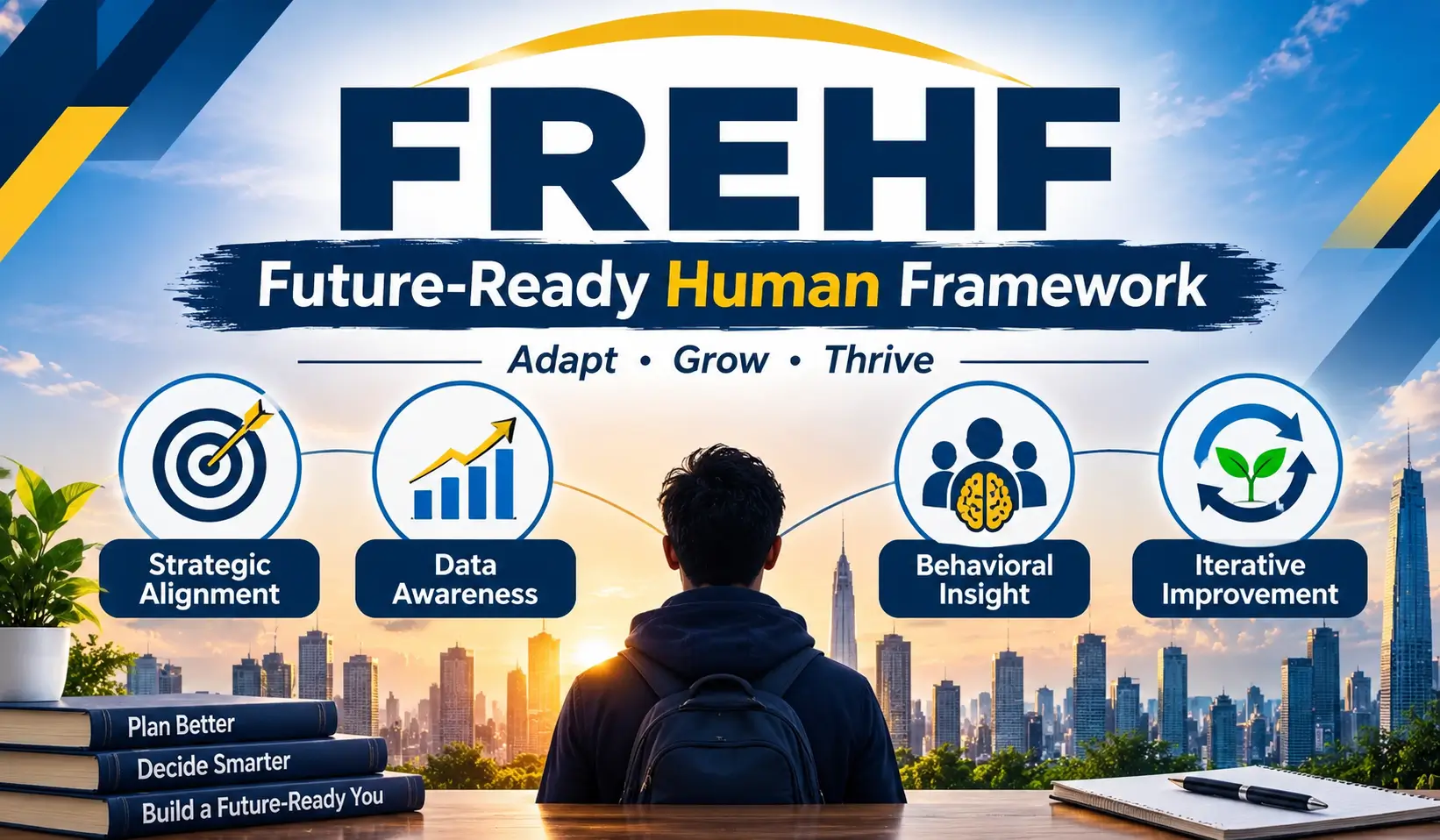
Frehf is an unusual term gaining attention across online discussions about productivity, business development, digital innovation, and personal growth. People searching for it may encounter descriptions of a modern management approach, a human-centred development framework, or an emerging concept connected with adaptability and continuous improvement. However, one important detail deserves attention: Frehf does not yet have one universally verified definition.
One commonly repeated interpretation expands FREHF as Future Ready Enhanced Human Framework. This description presents it as an approach to preparing individuals and organisations for changing environments while keeping human needs, informed decisions, and long-term development at the centre. Other online explanations use the term differently, so this expansion should be treated as a popular interpretation rather than a confirmed official full form. Gulf News+2
That uncertainty does not make the topic uninteresting. In fact, it creates an opportunity to examine what the term represents, why it is appearing in online searches, and how the practical ideas associated with it relate to established approaches to planning, leadership, technology, and personal improvement.
This guide explores nine useful principles commonly associated with the Frehf framework, explains its possible applications, and separates practical concepts from claims that still need independent verification.
1. What Is Frehf?
Frehf is an emerging online expression most commonly associated with planning, productivity, organisational development, and the ability to respond to change. Its clearest framework-related interpretation comes from an earlier version of the website Frehf.org, which presented it as a structured approach built around four connected principles.
These principles focus on four important areas:
- Setting clear goals and aligning everyday activities with larger objectives.
- Using relevant information to make better decisions.
- Understanding people’s behaviour, motivation, and practical needs.
- Improving processes through regular evaluation and adjustment.
Together, these ideas offer a way to examine how individuals and organisations approach challenges. Instead of focusing exclusively on targets or technology, the framework interpretation considers objectives, information, human behaviour, and continuous development.
It is important, however, to distinguish the framework description from an officially established business methodology. There is no independently verified governing organisation, universally accepted definition, or recognised certification that establishes Frehf as an industry standard.
The most useful way to understand it is as an informal framework concept that brings familiar management and productivity principles together.
2. What Does FREHF Stand For?
One of the most frequently repeated expansions of FREHF is Future Ready Enhanced Human Framework.
This phrase suggests an approach that prepares individuals and organisations for future challenges while maintaining a focus on human capabilities and needs.
Each part of the proposed expansion carries a particular idea.
Future Ready: Preparing for changes in technology, customer expectations, professional environments, and organisational requirements.
Enhanced: Improving existing processes, skills, communication, and decision-making rather than relying on outdated approaches.
Human: Recognising that people remain central to successful organisations, even when automation and digital tools become increasingly important.
Framework: Bringing different principles together within a structured way of thinking and working.
Although this expansion provides a useful explanation of the concept, it has not been independently confirmed as the original or official full form. Different websites describe Frehf in different ways, and no verified founder has established a definitive interpretation.
Therefore, readers should treat Future Ready Enhanced Human Framework as a commonly repeated explanation rather than an authenticated technical definition.
Why Does the Full Form Matter?
Understanding the proposed full form helps explain why Frehf is frequently discussed alongside business development and modern working practices.
Organisations are constantly adapting to new expectations. Technology changes how employees communicate, customers interact with companies, and businesses deliver services. Preparing for these developments requires more than purchasing new software.
It also involves improving people’s skills, understanding organisational weaknesses, setting priorities, and reviewing results.
The human-centred interpretation of Frehf brings these considerations into one discussion.
3. The 9 Powerful Principles Behind the Frehf Concept
The most identifiable version of the Frehf framework focuses on four pillars. However, its practical interpretation can be explored through nine broader principles that show how the ideas may apply to everyday situations.
These principles are not nine officially recognised components of a certified Frehf system. They are practical ways to understand and apply the framework’s reported ideas.
1. Strategic Alignment and Clear Direction
Strategic alignment is about ensuring that everyday activities contribute to larger objectives.
Many individuals and organisations struggle because they have numerous responsibilities but no clear understanding of which activities matter most. Employees may complete tasks without knowing how their work supports the company’s priorities. Individuals may remain busy throughout the day without making meaningful progress toward personal goals.
The strategic alignment principle encourages people to establish a clear direction before deciding how to use their time and resources.
For a business, this could mean connecting marketing activities with customer acquisition goals. If an organisation wants to improve customer satisfaction, its employees should understand how communication, response times, service quality, and problem resolution contribute to that objective.
For an individual, strategic alignment could involve connecting daily study sessions with examination goals or professional development plans.
Some useful practices include:
- Establishing measurable objectives.
- Identifying the activities that contribute directly to those objectives.
- Communicating responsibilities clearly.
- Reviewing priorities when circumstances change.
- Avoiding unnecessary tasks that consume valuable resources.
The main lesson is that meaningful progress requires direction. Working harder does not always produce better results when activities are disconnected from the desired outcome.
2. Data Awareness and Informed Decision-Making
Data awareness focuses on using relevant information instead of relying entirely on assumptions.
Modern businesses generate large amounts of information through customer interactions, financial reports, website analytics, sales records, employee feedback, and operational systems. However, collecting information is not the same as understanding it.
The real challenge is identifying which information matters and interpreting it correctly.
Consider an online business experiencing a decline in sales. The owner might assume that the problem is poor marketing and immediately increase advertising expenditure. However, the actual issue could involve confusing checkout pages, delivery delays, product availability, or changes in customer preferences.
Data awareness encourages the business to investigate the situation before making expensive decisions.
The same principle applies to personal development. Someone trying to improve productivity could record completed tasks, study hours, missed deadlines, or daily distractions. Reviewing this information may reveal patterns that are difficult to recognise through memory alone.
Useful data-awareness practices include:
- Identifying the information needed before making a decision.
- Checking whether the information is accurate and current.
- Comparing results across relevant periods.
- Recognising patterns rather than reacting to isolated events.
- Avoiding measurements that do not contribute to meaningful decisions.
Data should support human judgment, not replace it. Numbers can provide valuable insights, but they still require context and careful interpretation.
3. Behavioral Insight and Human Understanding
Behavioral insight is concerned with how people think, communicate, develop habits, and respond to different situations.
A plan may appear excellent on paper but fail when it does not consider the people expected to follow it.
For example, a company may introduce advanced software to improve productivity. The system might offer useful features, but employees could struggle because they have not received appropriate training. Some may resist the change because they do not understand its purpose, while others may find the new workflow unnecessarily complicated.
A manager who considers employee behaviour can identify these difficulties and provide better support.
This principle also applies to customers. Understanding why customers purchase products, abandon shopping carts, request assistance, or stop using a service can help businesses improve their experiences.
In personal development, behavioral insight encourages people to understand their own habits.
Someone who repeatedly postpones important tasks may need to examine distractions, workload, motivation, or unrealistic scheduling instead of simply creating another productivity timetable.
Practical ways to apply this principle include:
- Listening carefully to employee and customer feedback.
- Identifying obstacles that prevent people from completing tasks.
- Understanding individual working preferences.
- Creating realistic expectations.
- Providing training and appropriate support.
- Recognising that people respond differently to change.
Human understanding makes planning more realistic because it considers the people involved rather than treating them as interchangeable parts of a process.
4. Iterative Improvement and Continuous Development
Iterative improvement means making changes, reviewing their results, and adjusting the approach when necessary.
Instead of expecting a perfect solution immediately, individuals and organisations can begin with a reasonable plan and improve it through experience.
For example, a website owner might notice that visitors are leaving important pages quickly. The owner could review the content, improve navigation, simplify the layout, and monitor visitor behaviour after making changes.
If the results improve, the changes may be retained. If the problem continues, another adjustment can be considered.
The same approach works in education, business management, customer service, and personal productivity.
This principle resembles established continuous-improvement approaches, including the Plan-Do-Check-Act cycle and the Japanese concept of Kaizen. However, Frehf should not be confused with these established methods or presented as their official replacement.
A practical improvement process may include:
- Identify a specific problem.
- Develop a realistic improvement idea.
- Introduce the change on a manageable scale.
- Review the outcome using relevant information.
- Keep, adjust, or replace the approach.
- Repeat the process when necessary.
The objective is steady progress rather than unrealistic perfection.
5. Adaptability and Readiness for Change
Adaptability is essential in environments where expectations, technology, and working conditions can change quickly.
Businesses may experience new competitors, changing customer behaviour, supply difficulties, or unexpected financial pressures. Individuals may face changes in employment requirements, educational opportunities, or professional responsibilities.
A rigid approach can make it difficult to respond effectively.
The future-ready interpretation of Frehf encourages people to prepare for uncertainty instead of assuming that existing methods will always remain successful.
For organisations, adaptability may involve reviewing business strategies, developing employee skills, and evaluating new technologies before making major commitments.
For individuals, it could involve learning relevant digital skills, improving communication abilities, and remaining open to different career opportunities.
Adaptability does not mean changing direction whenever a new trend appears. Constantly abandoning plans can create confusion and waste resources.
Instead, it means recognising when circumstances genuinely require a different approach.
6. Human-Centred Technology and Responsible Innovation
Technology can improve efficiency, communication, and access to information. However, introducing a new digital tool does not automatically solve an organisational problem.
The human-centred interpretation of Frehf places importance on considering how technology affects the people who use it.
For example, a business might introduce artificial intelligence to handle routine customer enquiries. Automation could reduce repetitive work, but customers may still need access to human support when their problems are complicated or sensitive.
A successful system should consider both operational efficiency and customer experience.
The same thinking applies to employee management software, automated reporting, digital marketing platforms, and online collaboration tools.
Before introducing a new technology, organisations should consider:
- What problem is the technology expected to solve?
- Will employees receive appropriate training?
- Does the system protect customer and business information?
- Can users understand and operate it comfortably?
- Does it improve the existing process?
- Is human assistance available when automated systems fail?
Responsible innovation means selecting technology because it serves a genuine purpose, not simply because it is popular.
It also involves recognising the limitations of automation and maintaining appropriate human oversight.
7. Collaboration and Effective Communication
No individual or organisation operates successfully through isolated effort alone.
Businesses depend on communication between departments, employees, managers, suppliers, and customers. Educational environments depend on cooperation between students and teachers. Personal projects may require support from colleagues, friends, or professional communities.
The collaboration principle associated with a human-centred framework highlights the importance of shared understanding.
A team may have talented employees but still struggle when responsibilities are unclear. Important information may not reach the right people, deadlines may be misunderstood, and different departments may work toward conflicting objectives.
Effective communication helps reduce these problems.
Practical approaches include:
- Defining responsibilities before starting a project.
- Establishing clear communication channels.
- Sharing relevant information with the people who need it.
- Encouraging constructive feedback.
- Addressing misunderstandings early.
- Reviewing progress together.
Collaboration does not require everyone to agree on every decision. Different perspectives can improve problem-solving when people communicate respectfully and remain focused on shared objectives.
8. Accountability and Meaningful Measurement
A plan becomes more useful when people understand who is responsible for carrying it out and how progress will be evaluated.
Accountability is therefore an important practical extension of the Frehf concept.
In a business environment, employees should understand their responsibilities, managers should provide appropriate guidance, and teams should have realistic performance expectations.
Without accountability, even well-designed strategies can remain incomplete.
Measurement also matters. Businesses may monitor sales performance, customer satisfaction, project completion, or operational costs. Students may track examination preparation, completed assignments, and learning progress.
However, measurement should be connected to meaningful outcomes.
For example, counting the number of customer service calls handled by an employee does not necessarily reveal whether customers received satisfactory assistance. A better assessment might consider resolution quality, response time, and customer feedback together.
Useful accountability practices include:
- Assigning clear ownership of responsibilities.
- Setting realistic deadlines.
- Establishing relevant performance indicators.
- Reviewing progress regularly.
- Providing constructive feedback.
- Learning from mistakes rather than hiding them.
Accountability should encourage improvement, not create an environment where people are afraid to report problems.
9. Long-Term Growth and Sustainable Progress
The final principle is the importance of building progress that can be maintained over time.
Quick results may appear attractive, but decisions that create short-term improvements at the expense of long-term stability can produce additional problems.
For example, a business might reduce operating costs by eliminating employee training. This could improve immediate financial figures, but it may also create skill gaps, lower service quality, and reduce employee confidence.
A more sustainable approach considers the wider consequences of decisions.
Individuals can apply the same thinking to personal goals. Instead of following an unrealistic routine for a few days, they can develop manageable habits that fit their responsibilities and available resources.
Sustainable progress involves balancing ambition with practical limitations.
It encourages people to consider whether improvements can be maintained, whether resources are being used responsibly, and whether today’s decisions support future objectives.
These nine principles demonstrate how the Frehf concept can be interpreted as a practical way of thinking about development, rather than a guaranteed solution or independently validated system.
4. How Does the Frehf Framework Work?
The reported four-pillar framework can be understood as a repeating process involving goals, information, people, and improvement.
Each stage contributes to the next, creating a structured way to approach challenges.
Step 1: Establish a Clear Objective
Begin by identifying what needs to improve.
A vague objective such as becoming more successful is difficult to evaluate. A specific goal, such as reducing customer response times or completing a professional course, provides a clearer direction.
Step 2: Collect Relevant Information
Once the objective is established, identify the information needed to understand the current situation.
This may include performance reports, customer feedback, financial information, personal progress records, or employee observations.
The purpose is to understand the problem before choosing a solution.
Step 3: Consider Human Needs
Examine how the people involved may affect the outcome.
Consider their skills, expectations, motivation, responsibilities, and possible difficulties.
This stage helps ensure that the proposed solution is realistic.
Step 4: Introduce a Practical Improvement
Choose an appropriate action and implement it on a manageable scale.
A small change can provide useful information without requiring a large financial or operational commitment.
Step 5: Review the Results
Evaluate whether the change produced the intended outcome.
Use meaningful measurements and feedback instead of relying entirely on personal impressions.
Step 6: Adjust and Repeat
If the improvement works, consider maintaining or expanding it. If the results are disappointing, identify what needs to change.
The process can then begin again with a better understanding of the situation.
This is an illustrative application of the reported Frehf principles, not evidence of a proprietary method with guaranteed results.
5. How Frehf Can Be Applied in Business Management
Business management is one of the most relevant areas in which the reported Frehf principles can be explored.
Organisations regularly need to balance financial objectives, employee performance, customer expectations, technology, and operational responsibilities.
A structured approach can help managers examine these areas together.
Improving Business Operations
Operational problems can occur when departments use inconsistent procedures or employees lack clear responsibilities.
A business could begin by identifying the most important operational difficulties, reviewing performance information, and discussing problems with the people responsible for daily activities.
Management could then test improvements and evaluate their results.
Strengthening Customer Experience
Customer satisfaction depends on several factors, including communication, product quality, service reliability, and problem resolution.
Businesses can examine customer feedback to identify recurring complaints and areas requiring attention.
They can then improve support procedures, update information, or provide additional employee training.
Supporting Better Financial Decisions
Financial planning requires a clear understanding of income, expenses, available resources, and future commitments.
The principles associated with Frehf encourage businesses to connect financial decisions with larger objectives.
Instead of reducing costs without considering consequences, managers can examine which expenses contribute to meaningful results and which may be unnecessary.
Improving Team Performance
Employees are more likely to understand expectations when responsibilities and objectives are clearly communicated.
Managers can establish shared targets, monitor progress, and provide support when difficulties arise.
Regular discussions also create opportunities to identify problems before they affect wider operations.
6. Frehf for Personal Productivity and Self-Development
The concept is not limited to companies or professional management.
Its practical principles can also be adapted to personal routines, educational goals, and individual development.
Creating Better Daily Routines
People often struggle with productivity because they attempt to complete too many tasks without deciding which ones deserve priority.
A more structured approach begins with a few important objectives.
For example, a student might identify examination preparation as the main priority and divide the work into manageable study sessions.
Progress can then be reviewed to determine whether the schedule is realistic.
Developing Professional Skills
Professional development requires an understanding of current abilities and future requirements.
Someone interested in digital marketing, for example, might identify weaknesses in analytics, content strategy, or technical SEO.
They can then choose appropriate learning activities, practise the skills, and evaluate their progress.
This approach is more effective than collecting courses or certificates without a clear development objective.
Building Consistent Habits
Habits become easier to maintain when they fit real-life responsibilities.
Someone who wants to exercise regularly may begin with a manageable schedule instead of immediately adopting an unrealistic routine.
By observing what works and adjusting the plan, the individual can gradually establish more consistent behaviour.
Managing Personal Goals
Personal goals often involve several competing responsibilities.
The principles of strategic alignment and accountability can help individuals organise these commitments and monitor progress.
A simple notebook, calendar, or spreadsheet may be enough to support the process.
No special software is required to apply these general ideas.
7. Frehf and Digital Transformation
Digital transformation involves using technology to improve organisational processes, communication, services, and decision-making.
However, technology adoption can become expensive and ineffective when organisations fail to understand their actual needs.
The reported Frehf principles offer a useful way to examine digital transformation from a broader perspective.
Choosing the Right Technology
Businesses should identify the problem before selecting a tool.
A company experiencing communication difficulties may not need an expensive enterprise platform. It might benefit more from clearer procedures, improved documentation, or better use of existing software.
Technology should support an objective rather than become an objective by itself.
Understanding Data and Analytics
Digital systems can produce detailed information about customers, employees, and business operations.
However, organisations need to identify useful indicators and understand their limitations.
An increase in website traffic, for example, does not automatically mean that a business is generating more sales or attracting relevant customers.
Data should be interpreted in relation to the actual business goal.
Preparing Employees for Change
Employees may need training when new software or automated processes are introduced.
Management should explain why the change is happening, what employees are expected to do, and where they can receive assistance.
Ignoring these human factors can make even a technically successful project difficult to implement.
Reviewing Digital Performance
Technology requirements change as businesses grow.
Regular evaluation helps organisations determine whether existing systems remain useful, secure, and appropriate for their needs.
This creates opportunities to improve processes without replacing technology unnecessarily.
8. Is Frehf Connected to Artificial Intelligence?
Some online discussions associate Frehf with artificial intelligence, automation, and human-centred technology.
These associations are understandable because modern organisations increasingly use AI to support research, customer service, content production, data analysis, and routine administrative tasks.
The human-centred interpretation of Frehf suggests that technological development should consider people’s needs rather than focus exclusively on automation.
For example, a business using an AI-powered customer service system should evaluate more than the number of enquiries handled automatically.
It should also consider:
- Whether customers receive accurate information.
- Whether sensitive information is handled appropriately.
- Whether customers can reach human support.
- Whether employees understand the system’s limitations.
- Whether automation genuinely improves service quality.
Nevertheless, Frehf has not been independently verified as an official AI tool or software platform.
References to artificial intelligence in online articles should not be interpreted as proof that a functioning application exists under this name.
The broader principles can be applied when evaluating AI technology, but that is different from claiming that Frehf itself provides AI capabilities.
9. What Are the Main Benefits of the Frehf Approach?
The ideas associated with Frehf bring several familiar management and personal-development practices into one discussion.
Their potential value depends on how appropriately they are applied.
Clearer Objectives
Strategic alignment encourages people to understand what they are trying to achieve.
Clear objectives can make it easier to organise responsibilities and evaluate progress.
More Informed Decisions
Data awareness encourages people to investigate problems before choosing solutions.
This can reduce unnecessary guesswork, although the quality of decisions still depends on the accuracy and interpretation of information.
Greater Awareness of Human Needs
Behavioral insight reminds organisations that employees and customers have different expectations, abilities, and experiences.
Considering these differences can help create more realistic plans.
Improved Adaptability
Regular evaluation makes it easier to recognise when existing processes are no longer effective.
This can help organisations respond to changing conditions without abandoning every established practice.
Better Organisation
Connecting objectives, responsibilities, and measurements can reduce confusion.
Teams may find it easier to understand their priorities and coordinate their activities.
Consistent Development
Iterative improvement encourages people to make manageable changes and learn from their results.
However, these are potential advantages of the underlying principles. They should not be presented as scientifically demonstrated benefits unique to Frehf.
10. Frehf vs. Traditional Planning, Agile, and Kaizen
Understanding how Frehf compares with established approaches helps explain its position in the wider management landscape.
Frehf vs. Traditional Planning
Traditional planning can involve setting objectives, allocating resources, defining responsibilities, and establishing timelines.
The reported Frehf framework includes similar ideas but gives particular attention to data awareness, human behaviour, and ongoing improvement.
The main distinction is its proposed emphasis on connecting planning with people and repeated evaluation.
However, traditional planning is a broad category, not one single methodology. Many established planning approaches already include these considerations.
Frehf vs. Agile
Agile is an established approach to managing work through collaboration, adaptability, and repeated delivery.
It is particularly associated with software development, although its principles have been adapted to other professional environments.
Frehf’s reported emphasis on adaptability and improvement creates some similarities.
However, Agile has a documented professional history, established practices, and recognised communities of adoption. Frehf does not currently have the same independently established institutional standing.
They should not be treated as equivalent systems.
Frehf vs. Kaizen
Kaizen is a Japanese concept associated with continuous improvement.
It encourages organisations and individuals to make regular efforts to improve processes and performance.
The iterative-improvement principle associated with Frehf resembles this approach.
However, Kaizen has a documented history in Japanese management and manufacturing, whereas Frehf’s original development remains unclear.
The two concepts may share practical similarities without being the same methodology.
11. Is Frehf a Real App, Website, or Software Platform?
One source of confusion surrounding Frehf is the way some online articles describe it as a digital platform.
Certain explanations mention dashboards, automation, AI-assisted recommendations, productivity tracking, and team collaboration.
However, a functioning official software application with independently verified ownership, features, pricing, and documentation has not been established.
There is also no verified universal subscription structure or recognised official certification associated with the framework.
This distinction matters because a conceptual framework and a software product are two different things.
A framework explains a way of approaching a problem. Software provides a working technical system that users can access and operate.
The four general principles associated with Frehf can be applied using ordinary tools such as:
- Spreadsheets for tracking progress.
- Digital calendars for organising responsibilities.
- Project management software for coordinating teams.
- Analytics platforms for reviewing performance.
- Feedback forms for understanding customer experiences.
- Notebooks for recording personal goals and improvements.
These tools can support the underlying practices without requiring a dedicated Frehf application.
Readers should be cautious about websites that advertise specific Frehf software features without providing verifiable product documentation.
12. What Is Frehf.org and Why Is It Important?
Frehf.org is an identifiable website historically associated with the four-pillar interpretation of Frehf.
An earlier version of the website presented the concept as a structured approach focused on clarity, performance, and long-term adaptability.
Its reported framework included:
- Strategic Alignment.
- Data Awareness.
- Behavioral Insight.
- Iterative Improvement.
This earlier material provides an important starting point for understanding why the term is associated with business planning and productivity.
However, the website’s historical descriptions should not automatically be treated as proof of scientific validation or commercial adoption.
A website can publish a framework description without establishing that the framework has been independently tested, widely implemented, or recognised by professional institutions.
Reports published in 2026 also described the domain as having displayed an expiration notice. Its present status should not be assumed from older indexed material.
The most responsible approach is to separate the website’s earlier explanation from claims about current services, ownership, or official recognition.
13. Is Frehf Scientifically Proven?
This is one of the most important questions for anyone considering the framework.
There is no independently verified body of research establishing Frehf itself as a scientifically validated management system.
However, several ideas associated with its reported pillars are already established areas of professional and academic interest.
Strategic alignment is widely discussed in business management. Data-informed decision-making is an established practice in analytics and organisational planning. Behavioral insight is connected with psychology and behavioural economics. Continuous improvement has a long history in operations management.
The fact that these ideas have established foundations does not automatically validate a framework that combines them under a new name.
For Frehf to gain stronger scientific recognition, researchers would need to establish a clear definition, explain how the framework should be applied, and evaluate its results through transparent research.
Claims about specific productivity improvements, financial benefits, or employee performance gains would also require reliable measurements.
Until that evidence is available, it is better to evaluate the individual practices rather than assume that the Frehf label guarantees results.
14. Limitations and Challenges of Frehf
Although the principles associated with Frehf can be useful, several limitations deserve attention.
Unclear Original Meaning
The term does not have one universally accepted definition.
Some websites describe it as a business framework, while others associate it with digital technology, productivity, or informal online language.
This makes it difficult to determine which interpretation should be treated as authoritative.
Unverified Creator
No independently verified founder or original organisation has been established as the definitive creator of the framework.
Without this information, claims about its development and original purpose remain uncertain.
Limited Independent Research
There is no clearly established independent research base demonstrating the effectiveness of Frehf as a complete system.
Its individual principles may be useful, but specific results should not be assumed.
Confusion With Software Products
Some online explanations describe Frehf as an application or digital platform.
Without verified documentation, these claims should be treated carefully.
Risk of Unnecessary Complexity
Businesses already use established approaches to strategic planning, performance measurement, and continuous improvement.
Introducing another label does not automatically make these activities more effective.
If the terminology creates confusion without improving practical work, it may become an unnecessary complication.
Difficulty Measuring Results
A framework needs meaningful evaluation to demonstrate its value.
Organisations should identify specific objectives and compare results before and after introducing changes.
Without clear measurements, it becomes difficult to determine whether improvements came from the framework, other organisational changes, or unrelated circumstances.
15. How to Apply Frehf in Everyday Life
Someone interested in the reported Frehf principles does not need special training, a subscription, or dedicated software to experiment with them.
A simple approach can be used in everyday activities.
For students: Establish realistic learning goals, track completed study sessions, identify difficult subjects, and adjust the study schedule based on progress.
For professionals: Identify important career objectives, review current skills, seek constructive feedback, and develop a practical improvement plan.
For business owners: Connect daily operations with business goals, examine useful performance information, understand customer needs, and test manageable improvements.
For managers: Clarify responsibilities, communicate expectations, provide employee support, and review team performance regularly.
For content creators: Set publishing objectives, examine audience engagement, understand reader preferences, and improve content based on meaningful results.
For personal development: Identify habits that need attention, understand the reasons behind difficulties, make realistic changes, and evaluate progress over time.
The central idea is to approach improvement as an ongoing process rather than expecting immediate perfection.
16. Interesting Facts About Frehf
Here are some useful points that help summarise the term and its reported framework interpretation.
- Frehf is not a standard English dictionary word.
- Its meaning varies across online publications.
- One commonly repeated expansion is Future Ready Enhanced Human Framework.
- This full form has not been independently confirmed as official.
- An earlier version of Frehf.org described a four-pillar framework.
- Strategic Alignment is the first reported pillar.
- Data Awareness is the second reported pillar.
- Behavioral Insight is the third reported pillar.
- Iterative Improvement is the fourth reported pillar.
- The framework interpretation focuses on planning and adaptability.
- Its ideas can be applied to business management.
- Its principles can also be adapted to personal productivity.
- Some online articles associate Frehf with artificial intelligence.
- An official AI application under the name has not been independently verified.
- A recognised Frehf certification has not been established.
- Its principles overlap with established management practices.
- Its original founder remains unverified.
- Kaizen shares similarities with its iterative-improvement principle.
- Agile has a more established professional history.
- The framework can be explored using ordinary planning tools.
These facts highlight the difference between what the term is commonly associated with and what has been independently established.
Frequently Asked Questions About Frehf
1. What is Frehf?
Frehf is an emerging online term associated with productivity, planning, business development, and adaptability. Its clearest framework-related interpretation describes four principles: Strategic Alignment, Data Awareness, Behavioral Insight, and Iterative Improvement.
2. What does FREHF stand for?
The most frequently repeated expansion is Future Ready Enhanced Human Framework. However, this has not been independently confirmed as the original or official full form.
3. Is Frehf a real word?
Frehf is used in online publications, but it is not a widely recognised standard English dictionary word. It is better described as an emerging or coined expression.
4. What are the four pillars of Frehf?
The four reported pillars are Strategic Alignment, Data Awareness, Behavioral Insight, and Iterative Improvement. They focus on connecting objectives, information, human needs, and continuous development.
5. Who created Frehf?
No independently verified original founder or organisation has been established as the definitive creator of Frehf.
6. Is Frehf a business framework?
An earlier version of Frehf.org presented it as a structured framework for planning and improvement. Its ideas can be applied to business activities, but it is not an independently established industry standard.
7. Is Frehf an AI tool?
Frehf is sometimes discussed alongside artificial intelligence, but no official AI application under this name has been independently verified.
8. Does Frehf have an official website?
Frehf.org is historically associated with the four-pillar framework. However, its earlier descriptions do not establish the availability of a current official service or platform.
9. Is Frehf free to use?
There is no verified universal pricing structure for a Frehf product. The general planning and improvement principles can be explored using ordinary tools without purchasing a dedicated service.
10. Can Frehf improve productivity?
The principles associated with Frehf may help people organise responsibilities, understand problems, and review progress. However, specific productivity improvements unique to Frehf have not been independently demonstrated.
11. Can small businesses use Frehf?
Small businesses can adapt the reported principles to planning, customer service, employee management, and operational improvement. They can begin with simple goals, relevant information, and regular performance reviews.
12. Is Frehf similar to Agile?
Both concepts are associated with adaptability and improvement. However, Agile is an established professional approach with documented practices and widespread adoption, while Frehf does not have the same verified institutional history.
13. Is Frehf the same as Kaizen?
No. The iterative-improvement principle associated with Frehf resembles Kaizen, but the two are not identical. Kaizen has a documented background in continuous improvement and Japanese management practices.
14. Can students apply Frehf principles?
Yes. Students can use similar ideas to establish learning goals, track study progress, understand learning difficulties, and adjust their revision routines.
15. Is Frehf scientifically proven?
The complete Frehf framework has not been independently established as a scientifically validated system. Its individual principles relate to recognised areas of management, psychology, and continuous improvement.
16. Does Frehf require special software?
No dedicated software is required to explore the four reported principles. Calendars, spreadsheets, notebooks, and ordinary project management tools can support similar activities.
17. Why is Frehf appearing in online searches?
The unusual spelling and different explanations published online may encourage people to search for its meaning. However, the number of articles discussing a term does not prove that it represents a widely adopted professional framework.
18. What is the biggest advantage of Frehf?
Its most useful interpretation brings goals, information, human behaviour, and continuous improvement into one structured discussion. These elements can help people approach everyday challenges more thoughtfully.
19. What is the biggest limitation of Frehf?
Its unclear origin, inconsistent definitions, and lack of independent research make it difficult to evaluate claims about the framework as a complete system.
20. Is Frehf an officially recognised management standard?
No universally recognised professional or academic standard under the name Frehf has been independently established.
Conclusion
Frehf is an interesting emerging term associated with productivity, business planning, organisational development, and future readiness. Its most identifiable framework interpretation brings together four principles: Strategic Alignment, Data Awareness, Behavioral Insight, and Iterative Improvement.
These ideas provide a practical way to examine how people set goals, use information, understand human needs, and improve their activities over time. Their applications can extend across business management, education, digital transformation, professional development, and everyday productivity.
At the same time, it is important to recognise the limitations surrounding the term. Its original creator remains unverified, its commonly repeated full form has not been officially established, and there is no independent research confirming the complete framework as a scientifically validated system. Claims about dedicated software, AI capabilities, or guaranteed results should therefore be approached carefully.
Ultimately, the strongest value in the Frehf concept lies in the practical principles associated with it. Clear objectives, informed decisions, human understanding, and consistent improvement are useful foundations for personal and organisational growth, regardless of the name used to describe them.
For More Visits: NycMagazines.net