










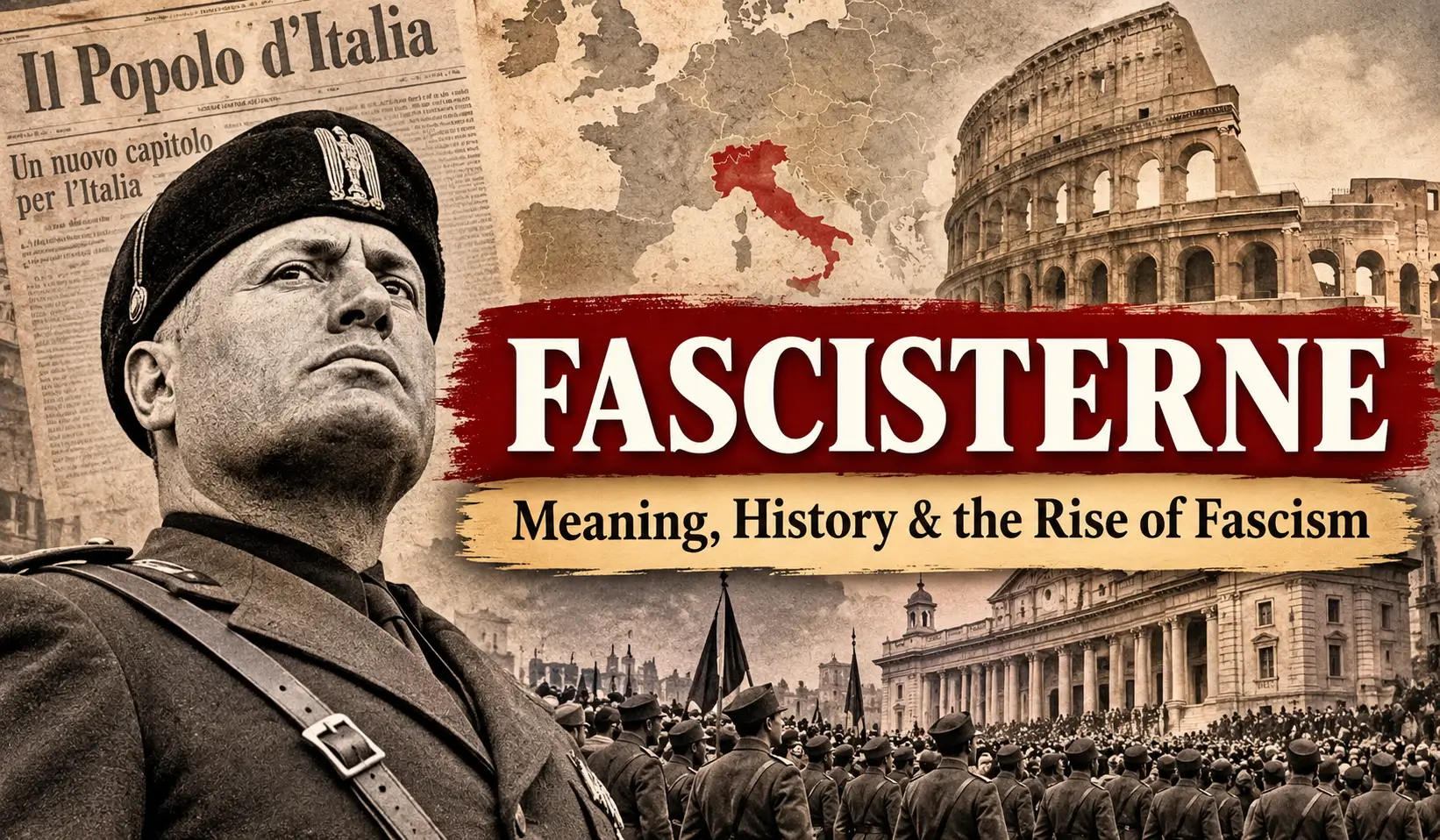
Fascisterne is a Danish term that translates into English as “the fascists.” It refers to people or political groups that support fascism, an authoritarian political ideology associated with extreme nationalism, dictatorial leadership, suppression of political opposition, and the concentration of power in a strong central state.
The term is connected to one of the most influential and controversial political movements of the twentieth century. Fascist movements reshaped European politics, contributed to major conflicts, and left a lasting impact on discussions about democracy, political freedom, nationalism, and human rights.
Understanding Fascisterne requires looking beyond the word itself. Its meaning becomes clearer when explored through the origins of fascism, its defining characteristics, its historical leaders, and its consequences for societies.
What Does Fascisterne Mean in Danish?
Fascisterne is the definite plural form of the Danish noun fascist. Danish often expresses definiteness by adding an ending to a noun instead of placing a separate word such as “the” before it.
The different forms are:
| Danish word | English meaning |
|---|---|
| Fascist | A fascist |
| Fascisten | The fascist |
| Fascister | Fascists |
| Fascisterne | The fascists |
| Fascisme | Fascism |
This distinction is important because Fascisterne describes people, whereas fascisme refers to the ideology itself.
The word does not automatically identify a particular political party, country, or historical movement. Its precise meaning depends on the surrounding text.
The Origins of Fascism
Fascism emerged as an organised political movement in Italy following the First World War. The war had created widespread economic difficulties, political instability, social divisions, and dissatisfaction with established political institutions.
Many Italians were frustrated by unemployment, inflation, strikes, and uncertainty about the country’s future. These conditions created opportunities for radical political movements promising national renewal, discipline, and strong leadership.
One of the central figures behind the movement was Benito Mussolini. In 1919, he established the Fasci Italiani di Combattimento, a political movement that later developed into the National Fascist Party.
Mussolini presented fascism as an alternative to liberal democracy and socialism. His movement promoted aggressive nationalism, loyalty to the state, military strength, and obedience to a powerful leader.
In October 1922, the March on Rome helped Mussolini secure the position of prime minister. Over the following years, he dismantled democratic institutions and established a dictatorship.
Italy became the first major country governed by a fascist regime, and its political model influenced movements in other parts of Europe.
Main Characteristics of Fascist Ideology
Fascism has appeared in different national forms, but historical fascist movements have shared several important characteristics.
Extreme Nationalism
Fascist movements place the nation at the centre of political life. They often promote the idea that national identity, unity, and strength must take priority over individual interests.
Their propaganda frequently presents the nation as threatened by internal enemies, foreign powers, or supposedly harmful social groups.
Authoritarian Leadership
Fascism supports concentrated political authority and strong leadership. The leader is presented as someone who represents the nation’s interests and deserves unquestioned loyalty.
This approach weakens democratic accountability and discourages criticism of those in power.
Suppression of Political Opposition
Historical fascist governments restricted political competition and attacked organisations that challenged their authority.
Opposition parties, independent newspapers, trade unions, and political activists faced censorship, intimidation, imprisonment, or violence.
Propaganda and Mass Mobilisation
Fascist movements used newspapers, radio, posters, public speeches, rallies, and organised demonstrations to influence public opinion.
Their propaganda promoted national pride, loyalty, military strength, and the image of a powerful leader. It also portrayed political opponents as enemies of the country.
Militarism and Political Violence
Fascist movements frequently celebrated military discipline, physical strength, and national expansion.
Violence was sometimes presented as an acceptable political instrument. Paramilitary organisations were used to intimidate opponents and strengthen the movement’s influence.
Hostility Toward Liberal Democracy
Fascist ideology rejects important principles of liberal democracy, including political pluralism, independent institutions, and the protection of individual rights.
Instead, it promotes national unity under centralised authority.
Famous Historical Fascist Leaders
Several political leaders became closely associated with fascist or related authoritarian movements during the twentieth century.
Benito Mussolini
Benito Mussolini was the founder of Italian Fascism and ruled Italy from 1922 until 1943.
He established an authoritarian government, restricted political freedoms, and promoted an aggressive nationalist agenda. His regime also pursued military expansion, including the invasion of Ethiopia in 1935.
Mussolini became one of the most recognisable figures in European fascist history.
Adolf Hitler
Adolf Hitler led the Nazi Party and became Germany’s chancellor in 1933.
Nazism was closely related to fascism but developed its own distinctive racial ideology, extreme antisemitism, and expansionist ambitions.
Hitler’s dictatorship was responsible for the Holocaust, the persecution and murder of millions of people, and the outbreak of the Second World War in Europe.
Francisco Franco
Francisco Franco ruled Spain from 1939 until his death in 1975.
His regime emerged from the Spanish Civil War and relied on authoritarian government, political repression, censorship, and nationalist ideology.
Although Franco’s government had important connections with European fascist movements, historians distinguish its political structure from the fully developed fascist regimes of Mussolini and Hitler.
Fascisterne and the History of Denmark
The term Fascisterne can also appear in discussions about Denmark’s political history.
Although Denmark did not become a fascist dictatorship, fascist and National Socialist movements existed there during the twentieth century.
One of the most significant organisations was the Danmarks Nationalsocialistiske Arbejderparti, commonly known as DNSAP. It was established in 1930 and modelled many aspects of its ideology and organisation on Germany’s Nazi Party.
DNSAP promoted nationalism, authoritarian leadership, and antisemitic ideas. Despite its political activities, it never achieved enough public support to take control of the Danish government.
Germany occupied Denmark in April 1940 during the Second World War. The occupation lasted until May 1945 and created major political and social challenges for Danish society.
During this period, Danish resistance movements developed, and opposition to German occupation became an important part of the country’s wartime history.
In this historical context, Fascisterne may refer to people associated with fascist or Nazi movements. However, it should not be treated as the official name of DNSAP or another specific organisation.
Fascisterne vs. Fascism vs. Nazism
These three terms are connected, but they do not have identical meanings.
| Term | Meaning |
|---|---|
| Fascisterne | Danish for “the fascists” |
| Fascism | An authoritarian ultranationalist political ideology |
| Nazism | The German National Socialist movement and its distinctive ideology |
Fascism developed in Italy, while Nazism emerged in Germany under Hitler. Both movements rejected liberal democracy, promoted authoritarian leadership, and used political violence and propaganda.
However, Nazi ideology placed particularly strong emphasis on racial hierarchy, antisemitism, and the idea of territorial expansion based on racial beliefs.
Understanding these distinctions helps prevent confusion when reading historical documents, political discussions, or translated material.
Why Is Fascisterne Still Relevant Today?
Although the major fascist regimes of the twentieth century collapsed, the historical meaning of fascism remains important.
The term continues to appear in discussions about authoritarianism, nationalism, political extremism, and the protection of democratic institutions.
Historical Education
Learning about fascist movements helps students understand how democratic systems can become vulnerable during periods of economic hardship, political instability, and social division.
Historical examples demonstrate how propaganda, political intimidation, and the weakening of independent institutions can contribute to authoritarian rule.
Political Discussions
Fascisterne may appear in modern Danish political conversations as a description of people considered fascist.
However, the word can also be used as a political accusation or insult. Calling someone a fascist does not automatically establish that the person or organisation genuinely follows fascist ideology.
A meaningful assessment requires examining political beliefs, policies, behaviour, and historical context.
Protecting Democratic Values
The history of fascism highlights the importance of free elections, independent journalism, freedom of expression, political accountability, and equal protection under the law.
These principles help prevent the concentration of unchecked power and protect individuals from political persecution.
How to Understand Fascisterne When Reading Danish
Readers who encounter Fascisterne in a Danish article, book, or historical document should consider the context before deciding exactly whom the word describes.
A few simple steps can help:
- Check the translation: The basic English meaning is “the fascists.”
- Identify the historical period: The text may discuss the 1920s, the Second World War, or contemporary politics.
- Look for a named organisation: The surrounding paragraphs may identify the specific movement.
- Understand the writer’s intention: The word may be used as a historical description, political criticism, or accusation.
- Separate facts from opinions: A political label should not be treated as proof without supporting evidence.
This approach is particularly useful for students, translators, researchers, and anyone interested in Scandinavian history.
Frequently Asked Questions About Fascisterne
What does Fascisterne mean in English?
Fascisterne is a Danish word meaning “the fascists.” It refers to people identified as supporters or members of fascist movements.
Is Fascisterne the name of a political organisation?
No. It is normally a Danish noun rather than the official name of a particular political organisation. Its specific reference depends on the context.
What is the difference between Fascisterne and Fascisme?
Fascisterne means “the fascists,” referring to people. Fascisme means “fascism,” referring to the political ideology.
When did fascism begin?
Modern fascism emerged as an organised political movement in Italy in 1919 under Benito Mussolini. It became a governing ideology when Mussolini established his dictatorship during the 1920s.
Was Denmark controlled by fascists?
Denmark was occupied by Nazi Germany from 1940 to 1945, but it did not become a fascist dictatorship. Danish fascist and National Socialist organisations existed, although they did not take control of the country’s government.
Are fascism and Nazism the same?
They are closely related but not identical. Nazism developed in Germany and included a particularly extreme racial ideology and antisemitism. Fascism also developed in other countries with different national characteristics.
Why is the word Fascisterne used in modern discussions?
It appears in Danish historical writing, journalism, political debate, and online conversations. Sometimes it describes historical movements, while in other situations it is used as a political label.
Is Fascisterne a singular or plural word?
It is plural and definite. The English translation is “the fascists,” while the singular definite Danish form is fascisten.
Conclusion
Fascisterne is a Danish word that means “the fascists,” but its significance extends beyond a simple translation. It connects to the history of fascism, an authoritarian political movement that influenced European governments, contributed to international conflict, and caused immense suffering during the twentieth century.
Understanding the word requires recognising the difference between people, political organisations, and ideologies. It also requires historical context, especially when discussing Italy, Germany, Denmark, and the Second World War.
Studying Fascisterne provides a useful starting point for exploring European political history and understanding why democratic freedoms, political accountability, and human rights remain essential.
For More Visits: NycMagazines.net