










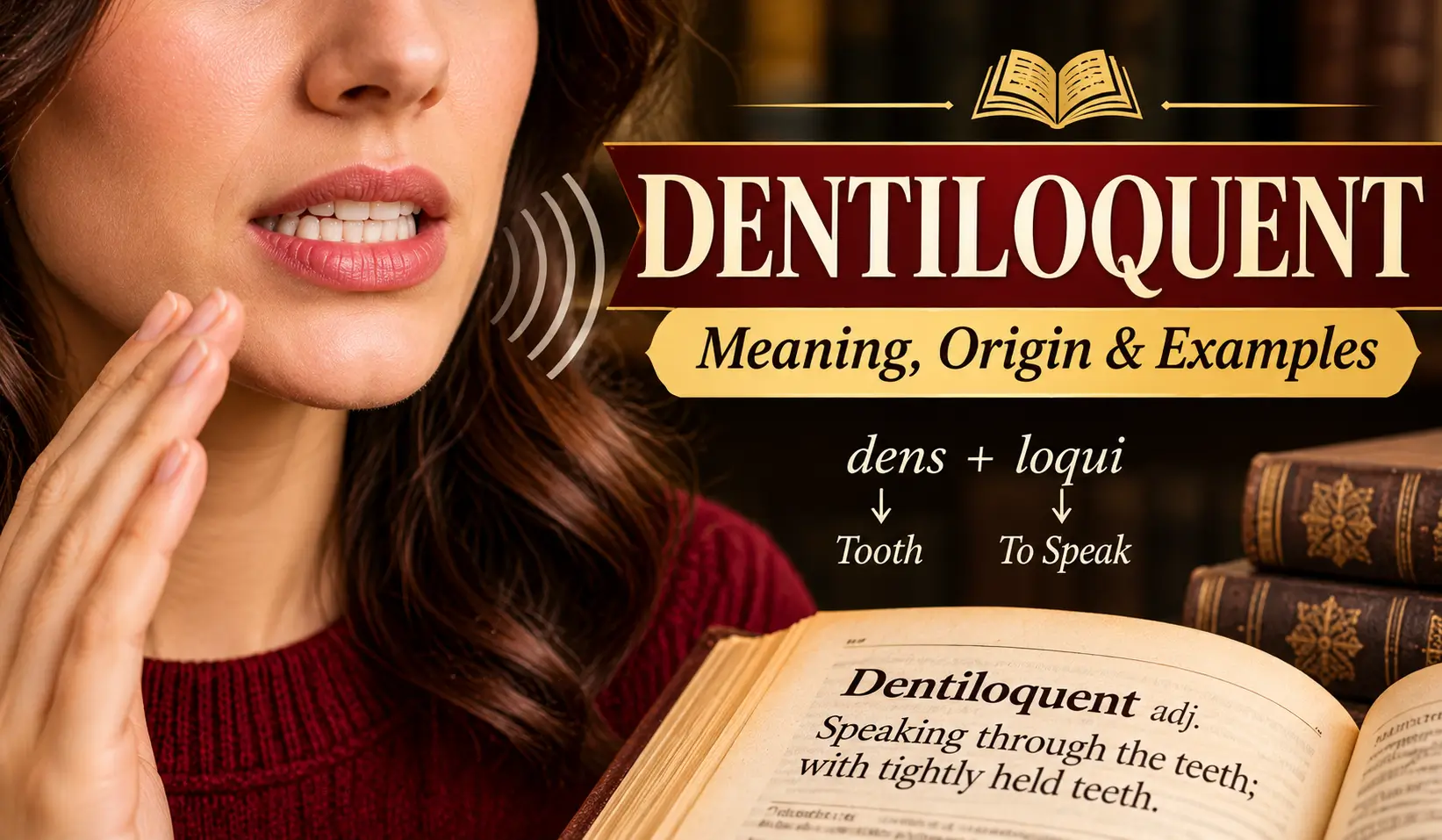
English contains many unusual words that describe things people experience every day but rarely know how to name. Some expressions explain emotions, others describe physical actions, and a few capture very specific ways of communicating. Dentiloquent belongs to this last category. It is an uncommon word associated with speaking through the teeth, particularly when the jaw is held tightly or the teeth remain closed.
Although the term is rarely heard in ordinary conversation, it has an interesting linguistic background. Its historical appearance in older English vocabulary references makes it more than a random internet expression. At the same time, its limited modern usage raises questions about whether it belongs in everyday English or is better suited to literary and descriptive writing.
Understanding dentiloquent involves more than learning a definition. Its related words, historical records, pronunciation, and practical examples help explain why this unusual term continues to attract attention.
What Does Dentiloquent Mean?
Dentiloquent is a rare English adjective that means speaking through the teeth or talking while keeping the teeth closely together.
Imagine someone who is frustrated during a conversation but does not want to raise their voice. Instead of speaking normally, they hold their jaw tight and force their words out between their teeth. That manner of speaking can be described as dentiloquent.
The word focuses on the physical way someone speaks rather than the meaning of their words.
For example, a person might say, “I will deal with this later,” while keeping their teeth clenched. The sentence itself sounds ordinary, but the delivery may communicate tension or irritation.
Dentiloquent can describe:
- A person speaking through tightly held teeth.
- A reply delivered with a restricted jaw movement.
- A warning spoken quietly but with visible tension.
- Dialogue in which a character deliberately controls their mouth while speaking.
The word does not automatically mean that someone is angry. A person may speak through their teeth because of cold weather, physical discomfort, nervousness, or an attempt to control their expression. The surrounding situation determines the emotion behind the speech.
Is Dentiloquent a Real English Word?
Dentiloquent is historically documented, although it is exceptionally uncommon in modern English.
One important historical reference is Thomas Blount’s Glossographia, published in 1656. The word appears in this early English dictionary, where it is connected with speaking through the teeth.
Its historical presence is also discussed in linguistic research. Allen Walker Read’s 1978 paper, The Sources of Ghost Words in English, examines unusual words that appeared in early dictionaries. Dentiloquent is included among examples of vocabulary associated with this discussion.
This history introduces an important distinction. A word can appear in a historical dictionary without necessarily becoming part of everyday speech. Some unusual terms remain in vocabulary collections for centuries, even when very few people use them in normal conversations.
The Collins English Dictionary website has also featured dentiloquent in its New Word Suggestion section. Its suggested meaning is talking through one’s teeth. However, a user-submitted suggestion is not the same as a fully established entry in a dictionary’s main vocabulary.
Therefore, dentiloquent is best described as a historically recorded but rare English adjective.
The Origin and Etymology of Dentiloquent
The structure of dentiloquent provides clues about its meaning. It combines elements associated with teeth and speech, both of which have connections to Latin vocabulary.
The first element relates to the Latin word dens, meaning tooth. This root is familiar in English words such as dental, dentist, and dentition.
The second element is associated with the Latin verb loqui, meaning to speak. This connection appears in several English words related to speech and expression.
Some examples include:
- Eloquent: Expressing thoughts effectively and persuasively.
- Loquacious: Talking a great deal.
- Soliloquy: A speech delivered by a character alone or expressing private thoughts.
- Ventriloquy: The art of producing speech while making the source of the voice appear different.
These connections make dentiloquent easier to understand. Its construction points toward the idea of speech involving the teeth.
However, the history of a word’s components should not be confused with proof of exactly when the complete adjective was first created. Its historical dictionary appearance provides evidence of its earlier documentation, but its precise development and frequency of use are separate questions.
Dentiloquent, Dentiloquy, and Dentiloquist: Understanding the Difference
Several related terms appear in discussions of speaking through the teeth. They are connected in meaning but serve different grammatical purposes.
Dentiloquent is the adjective. It describes a person, voice, response, or manner of speaking.
Dentiloquy is the noun. It refers to the act or practice of speaking through the teeth.
Dentiloquist describes a person who speaks in this manner.
The differences become clearer through examples:
- “His dentiloquent reply made the conversation uncomfortable.”
- “Her dentiloquy was noticeable during the argument.”
- “The character was portrayed as a dentiloquist.”
The noun dentiloquy has a particularly useful historical record. The Online Etymology Dictionary dates the term to 1737 and explains its connection with speaking through the teeth or with the teeth closed.
These related forms are useful when studying rare English vocabulary because they demonstrate how a single idea can appear in different grammatical forms.
How to Pronounce Dentiloquent
Dentiloquent is an uncommon word, so pronunciation references are less widely available than those for familiar English vocabulary.
A reasonable pronunciation guide is:
den-TIL-oh-kwent
The word can be divided into four parts:
- Den
- Til
- Oh
- Kwent
The second syllable receives the main emphasis in this approximate pronunciation.
The ending may initially look complicated, but it can be approached by comparing it with other English words containing the -loquent element.
Because the term is rare, this pronunciation should be treated as a practical guide rather than an officially standardized pronunciation supported by widely available audio references.
Dentiloquent in Everyday Situations
Although people rarely use the actual word, the behavior it describes is familiar.
Consider a disagreement between two friends. One person becomes frustrated but decides not to shout. They keep their mouth tightly closed and respond in a controlled voice. Their words may sound restrained, and their jaw may appear tense.
Another example involves someone working outside in extremely cold weather. Their teeth are almost touching, and they attempt to speak without opening their mouth fully. This situation can also fit the physical meaning of dentiloquent.
The word may also be useful when describing acting performances. An actor playing an irritated character might deliver a line through clenched teeth to communicate frustration without using a loud voice.
In each case, the physical delivery is the important detail.
Dentiloquent Examples in Sentences
Examples can make rare vocabulary easier to understand. The following sentences are original illustrations of how the word can be used.
1. He gave a dentiloquent response when his colleague questioned his decision.
2. Her dentiloquent warning made it clear that she was trying to control her frustration.
3. The actor delivered the final line in a dentiloquent voice, creating tension in the scene.
4. His words sounded calm, but his dentiloquent speech revealed how uncomfortable he felt.
5. She offered a dentiloquent reply rather than allowing her anger to become obvious.
6. The character’s dentiloquent manner of speaking added intensity to the confrontation.
7. Even while smiling, he spoke in a dentiloquent manner that suggested he was not pleased.
These examples demonstrate how the adjective can describe speech, a voice, or a particular response. Since the word is unfamiliar to many readers, it is usually helpful to explain its meaning when using it in general writing.
Dentiloquent vs. Mumbling: Are They the Same?
Dentiloquent and mumbling may sometimes sound similar, but they do not describe exactly the same thing.
Mumbling refers to speaking unclearly, often because someone speaks too quietly, does not pronounce words properly, or fails to articulate clearly.
Dentiloquent specifically concerns speaking through closely held or clenched teeth.
A person can speak through their teeth while still pronouncing every word clearly. Similarly, someone can mumble without keeping their teeth clenched.
Here is a simple comparison:
| Feature | Dentiloquent | Mumbling |
|---|---|---|
| Main meaning | Speaking through the teeth | Speaking unclearly |
| Main characteristic | Restricted jaw or closed teeth | Poor or indistinct articulation |
| Volume | Can be loud or quiet | Often quiet |
| Emotional connection | Depends on the situation | Depends on the situation |
| Common usage | Extremely rare | Common |
The difference is important for writers and vocabulary learners. Using these words interchangeably can change the meaning of a sentence.
Why Is Dentiloquent So Rare?
One reason dentiloquent remains uncommon is that English already has a simple expression for the same behavior: speaking through clenched teeth.
Most people naturally choose familiar language when communicating. They are more likely to say that someone spoke through their teeth than describe the person as dentiloquent.
The word also has a relatively specialized meaning. It does not describe a broad communication style or a common personality trait. Instead, it refers to a particular physical manner of speaking.
Its historical appearance in older vocabulary references may also contribute to its unusual reputation. Some readers discover it through collections of rare words, literary vocabulary, or online word explanations rather than through everyday conversation.
This does not make the word useless. It simply means that its most suitable applications are more limited than those of common descriptive adjectives.
Where Can Writers Use Dentiloquent?
Dentiloquent can be useful when a writer wants a precise and distinctive description of someone’s speech.
Fiction and storytelling
Writers can use the word to describe characters who speak through clenched teeth during arguments, confrontations, or emotionally difficult situations.
For example:
“Leave the room,” he said in a dentiloquent voice.
This description creates a particular image without requiring a long explanation of the character’s jaw movement.
Film and theatre reviews
The term may also help describe an actor’s performance. A character who speaks through their teeth can communicate tension without shouting or making exaggerated facial expressions.
Vocabulary and language learning
Students interested in unusual English words may find dentiloquent useful when studying Latin-derived vocabulary and word formation.
Creative descriptions
It can add variety to descriptive writing, particularly when the writer wants to avoid repeatedly using phrases such as “through clenched teeth.”
However, context matters. Since many readers will not recognize the term immediately, using a familiar expression may be more effective when clarity is the main priority.
Common Misunderstandings About Dentiloquent
Several misunderstandings can arise when people encounter rare vocabulary online.
It does not automatically mean anger. Although anger is one possible reason for speaking through clenched teeth, the word describes the manner of speaking rather than a specific emotion.
It is not the same as mumbling. Mumbling concerns unclear speech, while dentiloquent refers to speaking through the teeth.
It is not a dental diagnosis. The word describes a manner of speaking. It should not be presented as the name of a recognized dental or medical condition.
It is not commonly used in everyday English. Historical documentation does not mean that a word is widely understood or frequently spoken today.
A dictionary suggestion does not mean full dictionary acceptance. A proposed entry and a standard dictionary headword have different editorial statuses.
Understanding these distinctions helps readers use the word accurately rather than relying on exaggerated claims found in some online vocabulary articles.
Frequently Asked Questions About Dentiloquent
1. What does dentiloquent mean in simple words?
Dentiloquent means speaking through your teeth, usually while keeping the jaw tight or the teeth close together.
2. Is dentiloquent a real word?
Yes. It has historical documentation, including an appearance in Thomas Blount’s Glossographia from 1656. However, it remains extremely rare in modern English.
3. What part of speech is dentiloquent?
Dentiloquent is an adjective. It describes a person, voice, reply, or manner of speaking.
4. What is the noun form of dentiloquent?
The related noun is dentiloquy, which describes the act or practice of speaking through the teeth.
5. What is a dentiloquist?
A dentiloquist is a person who speaks through the teeth or with the teeth held closed.
6. Does dentiloquent mean speaking angrily?
Not necessarily. Anger can cause someone to speak through clenched teeth, but the word itself describes the physical manner of speaking rather than the person’s emotional state.
7. Is dentiloquent a medical term?
No. It is a descriptive vocabulary term, not a recognized medical diagnosis.
8. What is the difference between dentiloquent and eloquent?
Eloquent describes someone who expresses ideas clearly and effectively. Dentiloquent describes speech produced through the teeth. The words may look similar, but their meanings are different.
9. Is dentiloquent commonly used today?
No. It is an unusual and rarely encountered adjective. Most people use the expression “speaking through clenched teeth” instead.
10. Where does the word dentiloquent come from?
Its structure is associated with Latin elements relating to teeth and speaking. The related noun dentiloquy has a documented history in English vocabulary references.
Final Thoughts
Dentiloquent is an unusual English adjective with a surprisingly specific meaning: speaking through the teeth. Its historical appearance in older dictionaries, its relationship with dentiloquy and dentiloquist, and its Latin-based construction make it an interesting example of rare English vocabulary.
Although the word is not part of everyday conversation, it can be useful in literature, storytelling, and descriptive writing. It gives writers a compact way to describe a particular style of speech without relying on a longer phrase.
The most important thing to remember is that dentiloquent describes how someone speaks, not necessarily what they feel. A person may speak through clenched teeth because of anger, nervousness, cold, or discomfort. The situation provides the emotional meaning, while the word describes the physical manner of communication.
For More Visits: NycMagazines.net