








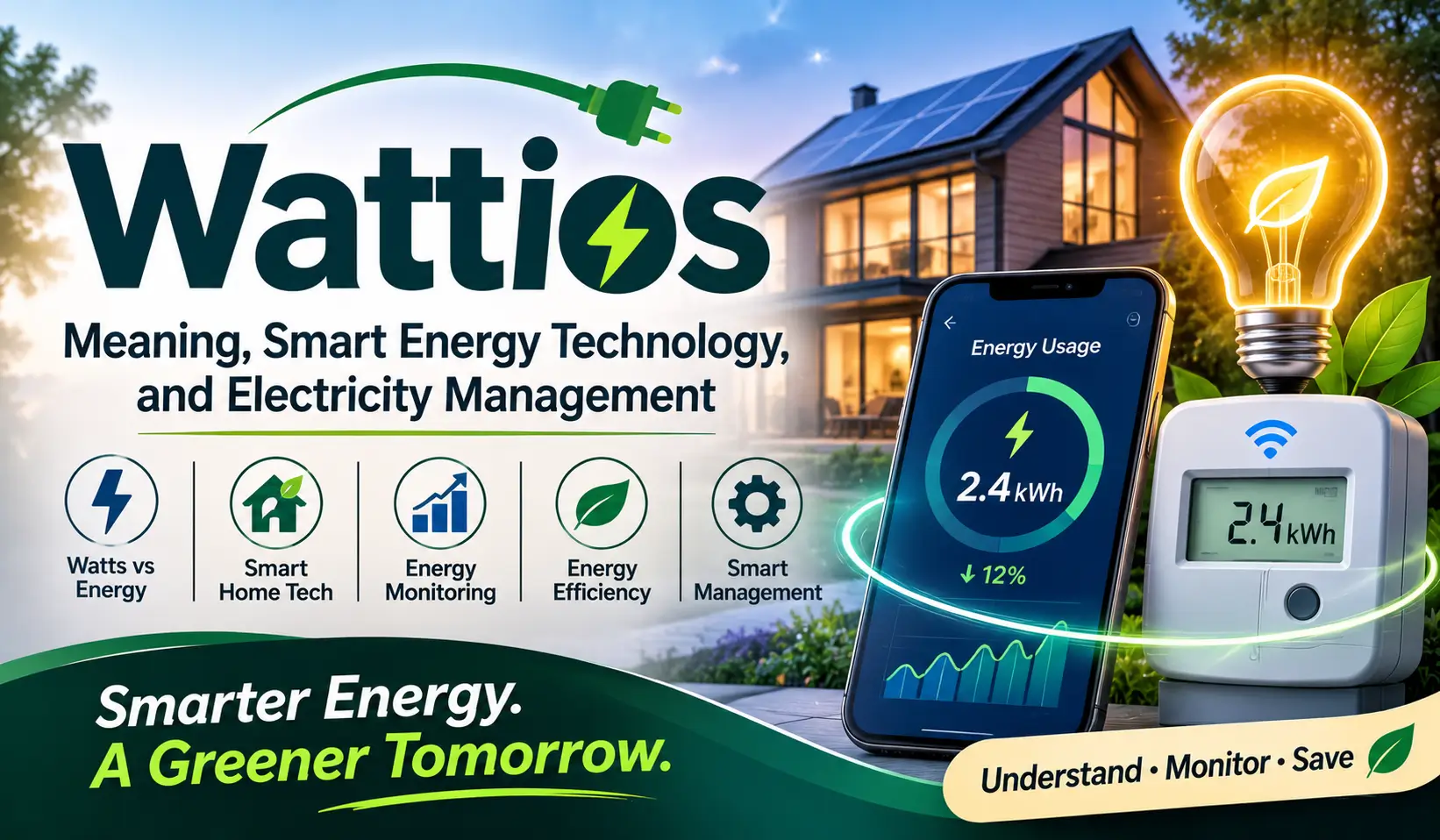
Wattios is a term associated with electricity, energy consumption, and smart home technology. People searching for it may encounter different explanations, including references to electrical power measurements, energy-monitoring solutions, and businesses using similar names. Understanding these distinctions is important because Wattios does not have one universally established meaning as a modern technology platform.
The term is closely connected to the word watt, the standard unit used to measure electrical power. It also appears in discussions about smart home systems, electricity monitoring, and energy efficiency. These subjects have become increasingly relevant as households and businesses look for practical ways to understand their electricity consumption and manage energy expenses.
This article explores what Wattios means, its connection to electrical measurements, how smart energy technology works, and what consumers should consider when evaluating products or businesses using this name.
What Is Wattios?
Wattios is a term associated with watts and electricity-related discussions. In historical Spanish usage, it has appeared as a form related to the electrical unit now commonly written as vatio in Spanish. In modern technical English, the recognised term is watt, represented by the symbol W.
The watt measures the rate at which electrical energy is transferred or consumed. It is used to describe the power requirements of household appliances, electronic devices, industrial equipment, and energy systems.
For example, an appliance rated at 1,000 watts uses power at a rate of one kilowatt while operating at its rated capacity.
The term Wattios can also appear as a commercial name. Different businesses may use similar names for energy-related products, services, or other activities. Therefore, readers should examine the context rather than assume every reference describes the same company or technology.
Understanding the Difference Between Watts and Energy Consumption
One of the most important concepts behind Wattios is understanding how electrical power differs from energy consumption.
Although these terms are closely related, they measure different things.
What Are Watts?
Watts measure power, which describes how quickly electrical energy is being used or produced.
Household appliances commonly display wattage ratings to indicate their power requirements.
Examples include:
- LED light bulbs rated at 5–15 watts
- Laptop chargers rated at 45–100 watts
- Microwave ovens rated at 700–1,500 watts
- Electric heaters rated at 1,000–2,000 watts
These figures describe power ratings, not the total electricity consumed over an entire month.
What Are Kilowatt-Hours?
A kilowatt-hour (kWh) measures the amount of energy consumed over time. Electricity providers commonly use this measurement when calculating household and commercial electricity bills.
For example, a 1,000-watt appliance operating continuously for one hour consumes approximately 1 kWh of electricity.
Understanding this difference helps consumers interpret appliance labels, electricity bills, and energy-monitoring reports.
Why Does This Difference Matter?
A high-wattage appliance does not necessarily consume more electricity than every lower-wattage device.
Operating time also matters.
A 2,000-watt heater running for 30 minutes consumes approximately 1 kWh. A 100-watt device operating continuously for 10 hours consumes the same amount.
This means consumers should consider both power ratings and usage patterns when evaluating electricity costs.
Wattios and Smart Home Technology
Smart home technology has changed how people interact with household appliances and electrical systems. Instead of manually checking every device, connected equipment can provide information about energy usage, operating schedules, and automation.
The term Wattios sometimes appears in discussions about these technologies, although it should not automatically be treated as the name of a verified smart energy platform.
Smart home systems generally combine compatible hardware, software, sensors, and communication technologies to help users monitor or control household equipment.
Smart Energy Monitoring
Energy-monitoring devices help households understand how much electricity they consume.
Depending on the equipment, monitoring may cover an entire property or individual appliances.
Some systems display real-time power consumption, while others provide historical information that helps users identify usage patterns.
This information can help answer practical questions:
- Which appliances consume the most electricity?
- When does household electricity consumption increase?
- Are devices using power while not actively operating?
- How much electricity does a particular appliance consume?
- Are there opportunities to reduce unnecessary usage?
Energy monitoring provides visibility into electricity consumption, making it easier to identify areas where changes may be useful.
Connected Appliances
Connected appliances allow users to manage certain functions through mobile applications or home automation systems.
Depending on compatibility, these devices may support remote switching, scheduled operation, automated settings, and usage monitoring.
For example, a compatible smart plug may allow someone to switch a connected lamp off through a mobile application.
These features can improve convenience and help users manage electricity use more effectively.
Automated Energy Management
Automation allows connected devices to operate according to predefined conditions.
A smart thermostat, for example, can adjust heating or cooling settings according to a schedule. Some systems can also respond to occupancy, temperature, or other sensor readings.
Automation does not automatically guarantee lower electricity bills. Its effectiveness depends on the equipment, household routines, settings, and overall energy consumption.
Wattios and Energy Efficiency
Energy efficiency refers to using less energy to achieve the same or a similar result.
It is an important consideration for households, businesses, and industrial facilities because electricity consumption affects operating expenses and environmental impact.
Understanding wattage and energy usage can help people make better decisions about the equipment they use.
Choosing Efficient Appliances
When purchasing electrical equipment, consumers should examine more than the advertised power rating.
Energy labels, efficiency ratings, operating requirements, and expected usage should all be considered.
For example, an efficient refrigerator may use less electricity over time than an older model with similar storage capacity.
The initial purchase price is only one part of the decision. Long-term operating expenses can also influence the overall value of an appliance.
Reducing Standby Consumption
Some electronic devices continue consuming electricity when they are not actively being used.
This is commonly called standby or idle power consumption.
Individual devices may use relatively small amounts of electricity, but unnecessary consumption across multiple appliances can accumulate over time.
Consumers can review their usage habits, switch off equipment when appropriate, and use compatible power-management features to reduce avoidable consumption.
Improving Heating and Cooling Efficiency
Heating and cooling systems can account for a significant portion of household electricity use.
Maintaining suitable temperature settings, cleaning filters, improving insulation, and using programmable controls can help manage consumption.
The actual savings depend on climate conditions, equipment efficiency, building design, and operating habits.
How to Calculate Electricity Consumption
Understanding electricity calculations is useful when evaluating appliances or reviewing household energy expenses.
A basic calculation can estimate the energy consumed by an appliance over a specific period.
The formula is:
Electricity Consumption (kWh) = Power (W) × Operating Hours ÷ 1,000
Consider a device rated at 500 watts that operates for four hours.
- Power rating: 500 watts
- Operating time: 4 hours
- Total consumption: 2,000 watt-hours
- Electricity consumption: 2 kWh
Example calculation assumes the appliance draws a constant 500 watts throughout operation.
To estimate the electricity cost, multiply the total consumption by the applicable electricity tariff.
For example, if the electricity rate is $0.20 per kWh, consuming 2 kWh would cost approximately $0.40.
Actual electricity bills may also include taxes, fixed charges, adjustments, and other fees.
Wattios and Solar Energy
Solar energy is another area where understanding watts and kilowatt-hours is important.
Solar panels convert sunlight into electrical energy. Their rated capacity is generally expressed in watts or kilowatts, while the energy they generate over time is measured in kilowatt-hours.
For example, a solar installation rated at 5 kW describes its nominal power capacity under specified conditions. It does not mean the system generates 5 kWh every hour throughout the day.
Actual electricity production depends on several factors:
- Sunlight availability
- Panel orientation
- Weather conditions
- Temperature
- Shading
- System efficiency
- Inverter performance
Battery storage can also be included in a solar installation. It allows compatible systems to store electricity for later use.
Consumers researching solar solutions should compare equipment specifications, installation costs, warranties, financing conditions, and projected energy production.
Any business using the Wattios name in connection with solar services should be evaluated independently. A similar brand name does not establish that different energy companies or products are connected.
Wattios and the Development of Smart Home Systems
The development of connected home technology has created new opportunities for managing electricity consumption.
Earlier household electrical systems generally required users to operate appliances manually. Modern smart home equipment introduces additional controls through connected devices and applications.
The Spanish company Wattio, for example, was associated with smart home technology and products designed around energy monitoring, heating management, and connected appliance control.
Its historical product concept reflected a broader movement towards making household energy information easier to access.
However, consumers researching older Wattio products should verify current compatibility, manufacturer support, application availability, and cloud-service status before purchasing second-hand equipment.
This distinction is important because historical product availability does not guarantee that a connected device will continue functioning with modern software or network systems.
Benefits of Understanding Wattios and Electrical Power
Learning about electrical measurements provides practical benefits beyond understanding a technical term.
Better Electricity Awareness
Understanding watts and kilowatt-hours helps consumers interpret electricity bills and appliance specifications.
Instead of focusing only on monthly charges, they can examine how equipment usage contributes to overall consumption.
More Informed Purchasing Decisions
Comparing power ratings and energy-efficiency information can help consumers evaluate appliances before purchasing them.
This is particularly important for equipment that operates for extended periods, such as refrigerators, air conditioners, and heating systems.
Improved Household Planning
Electricity calculations can help households estimate operating expenses and plan their energy requirements.
This information may also be useful when considering solar installations or battery storage.
Greater Understanding of Smart Technology
Knowledge of electrical measurements makes it easier to understand the information provided by smart meters, energy monitors, and connected appliances.
Users can interpret consumption reports more confidently and identify practical opportunities for improvement.
Better Business Energy Management
Businesses often operate multiple electrical devices, machines, and systems.
Understanding power requirements can support equipment planning, operational budgeting, and energy-efficiency initiatives.
Is Wattios a Company, Product, or Measurement Unit?
The meaning of Wattios depends on the context in which the term appears.
It can be associated with historical electrical terminology, commercial names, and discussions about energy-related technology.
However, Wattios is not a separate internationally recognised modern SI unit. The standard unit of electrical power is the watt, represented by W.
Similarly, the name alone does not establish that a particular website or business offers a verified energy-monitoring application, solar installation service, or smart home product.
Before interacting with a company using this name, consumers should check its official business identity, product specifications, service terms, contact information, and independent customer feedback.
How to Evaluate a Wattios-Related Energy Service
Consumers researching energy products or services should approach marketing claims carefully.
Energy-related purchases can involve significant costs, long-term agreements, and technical requirements. Verifying the provider’s identity and understanding the proposed solution are essential.
Consider these factors:
1. Verify the company: Check its registered business name, operating location, and available contact information.
2. Understand the technology: Ask which monitoring devices, sensors, software, or energy systems are included.
3. Review the pricing: Examine equipment costs, installation charges, financing arrangements, and recurring fees.
4. Check compatibility: Confirm that proposed equipment works with your existing electrical system and connected devices.
5. Evaluate savings claims: Request a clear explanation of how projected savings are calculated.
6. Review the agreement: Understand warranties, cancellation terms, maintenance responsibilities, and customer support arrangements.
These steps can help consumers distinguish practical energy solutions from unsupported marketing claims.
Frequently Asked Questions About Wattios
1. What does Wattios mean?
Wattios is a term historically associated with the word watt in Spanish-language electrical terminology. It also appears in commercial and energy-related contexts.
2. Is Wattios an official electrical measurement unit?
No. The internationally recognised SI unit of power is the watt, represented by the symbol W. Wattios is not a separate modern SI unit.
3. Are Wattios and watts the same?
They are historically related terms, but modern technical English uses watt. In Spanish, the standard modern term is vatio, with vatios as its plural.
4. What is the difference between watts and kilowatt-hours?
Watts measure electrical power, while kilowatt-hours measure the amount of energy consumed over time. Both measurements are important when understanding appliance usage and electricity bills.
5. Can energy monitoring help reduce electricity bills?
Energy monitoring can help identify consumption patterns and unnecessary electricity usage. Actual savings depend on the actions taken, appliance efficiency, operating habits, and electricity prices.
6. Is Wattios a smart home platform?
The name appears in discussions about smart energy and connected home technology, but it should not automatically be treated as a single verified modern platform. Specific products and companies need to be evaluated independently.
7. Is Wattios connected to solar energy?
The term appears in some commercial energy-related contexts, including solar services. However, consumers should verify the exact business and its offerings before assuming that a particular Wattios-branded service provides solar installations.
8. How can I calculate electricity consumption?
Multiply an appliance’s wattage by its operating hours and divide the result by 1,000. The answer gives an approximate consumption figure in kilowatt-hours.
9. Can smart home devices improve energy efficiency?
Compatible smart devices can support scheduled operation, remote controls, and energy monitoring. Their effectiveness depends on the equipment, settings, and how people use them.
Final Thoughts
Wattios is a term connected to electrical power, energy consumption, and discussions about smart home technology. Although it may appear as a company or product name in certain contexts, it should not be confused with a separate modern electrical measurement unit.
Understanding watts and kilowatt-hours provides a more useful foundation for evaluating electricity usage, comparing appliances, and exploring energy-efficiency solutions.
Smart meters, connected appliances, solar systems, and energy-monitoring technologies can all help consumers gain better visibility into their electricity consumption. However, the benefits depend on choosing appropriate equipment and using accurate information.
Ultimately, understanding the principles behind Wattios helps households and businesses approach electricity management more confidently and make better-informed decisions about energy use.
For More Visits: NycMagazines.net